
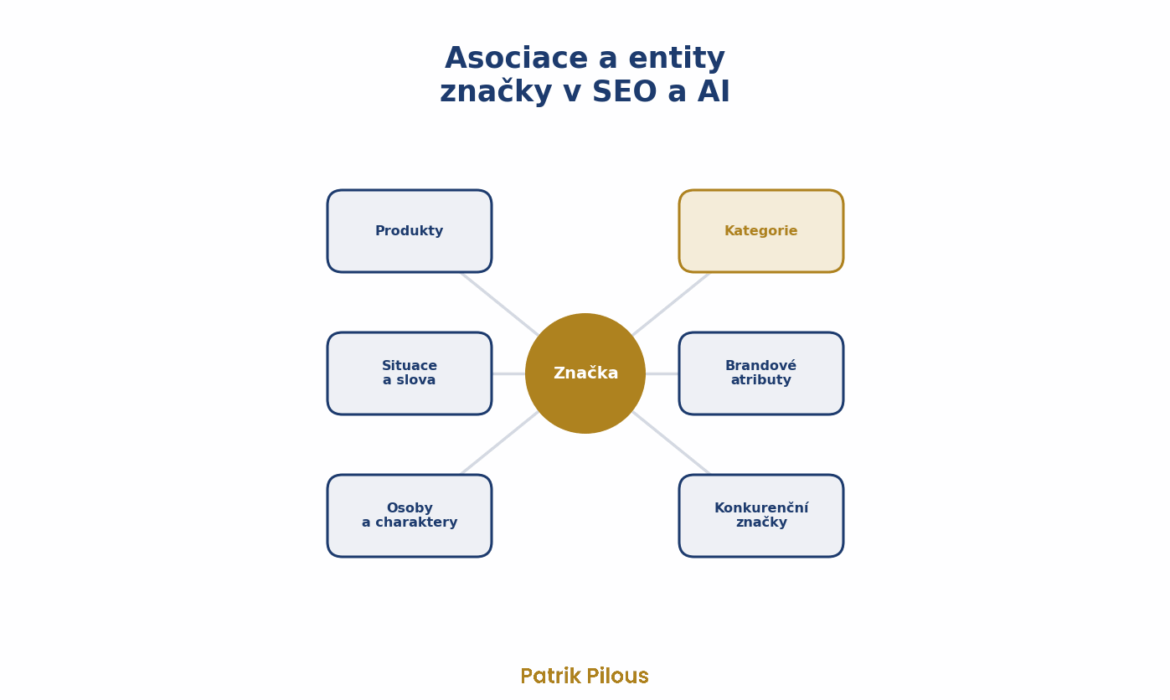
A brand has two layers in a customer’s mind. The entity, a clear idea of who the brand is, and around it a network of associations that people link to it. Search engines and language models such as ChatGPT or Gemini build their picture of a brand in a similar way, from what the web says about it. If you want to be visible in Google and in AI answers, you need a strong entity surrounded by associations that the internet repeats.
I cover associations from a psychological point of view in the article Brand associations, how they form and why they matter. Here I look at them through the lens of SEO and GEO, meaning search and AI answers.
What an entity is and what associations are
An entity is a brand as a separate, clearly defined subject. It has a name, a field, people, a story and, above all, an answer to the question of who it is, who it is for and how it differs. You will not confuse a strong entity with competitors or with a category. When someone says Apple in marketing, nobody pictures a piece of fruit.
Associations are the links that lead out from the entity. Say Alza and people think of electronics, AlzaBoxes and the green alien. The more strong links a brand has, the more easily someone remembers it at the moment they need something. When buying, people usually only seriously consider a few brands that come to mind first.
The entity is the centre, the associations are the lines around it. Without a clear centre, the associations have nothing to hold on to. When an online shop has the same name as the category it sells, customers remember the category, not the shop.
Marketing described this back in 1993. Kevin Lane Keller, then at Stanford University, compared brand knowledge to a network in memory in the Journal of Marketing. It is made up of brand awareness and brand image, meaning a set of associations.
“Brand equity occurs when the customer holds favourable, strong and unique brand associations in memory.”
abstract of the article Conceptualizing, Measuring, and Managing Customer-Based Brand Equity by Kevin Lane Keller, Journal of Marketing, 1993
Keller was talking about human memory, not AI. Applying these three qualities to what to watch in language model answers is my own loose adaptation.
| Association quality | What it means | How to spot it in AI answers |
|---|---|---|
| Strength | how easily people link the brand to the topic | how often AI mentions you for questions in your category |
| Favourability | whether the link is good for the customer | the tone AI uses when talking about you |
| Uniqueness | whether competitors have it too | whether it describes you with something it does not say about others |
In my experience, the third one is missing most often. A brand that AI describes in the same words as three competitors may have strong and favourable associations, but nothing that would make the model recommend it first.
What makes a strong entity
A logo or a single campaign will not create a strong entity. It is made up of several things that must make sense together and be repeated everywhere people talk about the brand.
- A name nobody confuses. Do you share it with a town, a product or a whole category? Then you constantly have to explain what you do. The more generic the name, the more work.
- One sentence. Who you are, who you serve and how you differ. Your brand positioning and unique selling proposition both come from it.
- Recognisable elements. A colour, a mascot, a slogan, a packaging shape. The Nike swoosh works even without the name.
- People and a story. A founder or the face of a brand gives the entity a character that people remember more easily than a company.
- The same facts everywhere. Name, founding year, registered office, product range. 2008 on the website and 2010 on LinkedIn confuses customers and machines alike.
Search engines adopted this logic. In 2012, Google launched the Knowledge Graph with the motto “things, not strings”, and since then it has treated brands as entities, not as strings of characters. In 2020, according to Google, it held over 500 billion facts about five billion entities.
Google takes facts from hundreds of sources, and it says Wikipedia is just one of them. For companies, these are mainly the website, directories, Wikidata, the Google Business Profile and structured data. When the sources say the same thing, Google recognises the entity. When they contradict each other, it does not know what to trust.
How to find out whether Google knows you as an entity
Before you start building your entity, find out where you stand. A rough check takes three steps, and only the middle one is technical.
1. Search for your name. Does a panel with your brand, logo and website appear? Then Google almost certainly knows you as an entity. If the panel is missing, that does not automatically mean the opposite. But if a different company, a town or a general term appears instead of you, you have a name that gets confused with others.
2. Have a developer query the Knowledge Graph. Google has a public interface, the Knowledge Graph Search API, which returns matching entities for a name. Google itself warns that it is not built for production use, so it is a rough check, not a measurement.
3. Compare facts across sources. Go through the places in the table and note where the details differ. Every inconsistency in the founding year or the field is a reason for machines to doubt.
| Where | What to check |
|---|---|
| Your own website, About us page and footer | name, founding year, registered office, company ID number (IČO), what the company does |
| Google Business Profile | name, category, address, website link |
| Firmy.cz and industry directories | the same details and the same description of the field |
| LinkedIn and social networks | name, description, founding year |
| Wikidata | whether an item exists and links to the right website |
| Commercial Register (obchodní rejstřík) | official name and registered office that other sources refer to |
Wikidata is not a business directory where a brand can list itself, though. According to the Wikidata rules, an item must be based on serious and publicly available sources, and paid edits must be disclosed. So first check whether an item exists and is accurate, and mainly correct obvious errors with a reference to a source.
How to describe your entity with structured data
Once you know where you stand, describe your entity to Google in machine-readable form too. Your homepage should have Organization structured data. According to Google’s documentation, it helps the search engine understand details about the company and distinguish it from other organisations in the results. Focus on properties that can also be verified elsewhere.
| Property | What goes in it |
|---|---|
| name and alternateName | official name and variants people know you by |
| legalName | company name from the Commercial Register |
| url and logo | website address and logo |
| description | one sentence about the company, the same as in directories and on LinkedIn |
| foundingDate and address | founding year and registered office, the same as everywhere else |
| vatID | VAT number (DIČ), if you are VAT registered |
| sameAs | links to profiles that belong to you, such as LinkedIn, Wikidata or social networks |
The schema.org vocabulary, founded jointly by Google, Microsoft, Yahoo and Yandex, describes sameAs as a link to a page that unambiguously indicates the identity of the item, typically Wikipedia, Wikidata or an official website. It is your own statement and verifies nothing on its own. But it connects the places where a machine can verify facts about you.
Structured data alone will not get you into AI answers. They help Google recognise you and not confuse you with others, but what AI says about you depends on what the rest of the internet says.
Why AI needs both an entity and associations
A language model does not store your website like an archive. From its training data it mainly takes away which words, categories and competitors your name appears with, and whatever is repeated often in the data has a greater chance of being repeated in an answer. When it also searches the web, like Perplexity or ChatGPT with search, it reads what it finds about you right now.
Where information about you is missing or contradictory, the model fills the gaps with whatever sounds plausible. Hallucinations have several causes. Consistent, findable facts about your brand reduce the risk, and unlike the other causes, they are in your own hands.
Ahrefs compared 75,000 brands, and the number of brand mentions on the web correlated more strongly with visibility in Google’s AI Mode (correlation 0.71) than domain strength measured by Domain Rating (0.29). Across tools, YouTube mentions came out strongest, at around 0.74. This is correlation, not proof of causation, and Ahrefs sells AI visibility tracking, so take it with a pinch of salt.
Links have not stopped mattering, though, they just work somewhere other than you might expect. Common Crawl is an open web archive that many large models draw training data from. According to Sebastian Nagel of Common Crawl, in 2022 the best-linked domains had a limit of up to 35 million URLs, while domains with almost no links pointing to them had a limit of just a thousand.
Why does this matter? AI answers take the place of clicks. In March 2025, the Pew Research Center tracked the browsing of 900 American adults. When an AI summary appeared above Google’s results, they clicked a traditional link in 8% of visits, compared with 15% without a summary. They clicked a link inside the summary itself in only 1% of visits.
If you are missing from the answer, you lose contact with the customer, even if you rank high in the results below it. And according to Google’s documentation on AI features, there are no special rules or special structured data for AI Overviews and AI Mode in Google.
“There are no additional requirements to appear in AI Overviews or AI Mode.”
Google Search Central, AI features and your website, 2025
In my view, this means an entity and associations are built through the same work as visibility in Google. It is just that what others say about you matters more than what you say yourself.
Six categories in which to monitor associations
I work with clients on six categories of associations that lead from the brand entity. Each one can be influenced through your website, anchor texts and external mentions, and each one can be checked with questions you ask AI repeatedly.
- Products. What you sell. “What does X sell?”
- Category. The broader area where you want to be the first choice. “Where can I buy a gift for a man?” Do you come up?
- Brand attributes. What the brand is like. “What is brand X like?”
- Competing brands. Who AI compares you with. “What are the alternatives to X?”
- People and characters. The founder, the face or the mascot. “Who is behind X?”
- Situations and related words. The moments when a customer should think of you. “What should I buy my dad for Christmas?”
With Alza, you can see it even without measuring. The products are laptops and mobile phones, the category is electronics, the attributes are speed and a huge selection, and it is compared with Datart or CZC. For people and characters it has Alzák, and for situations “I need it now”. It has all six categories covered and tells the same story everywhere.
The opposite is easy to see with Manboxeo, an e-shop selling original gifts that I have worked with for a long time.
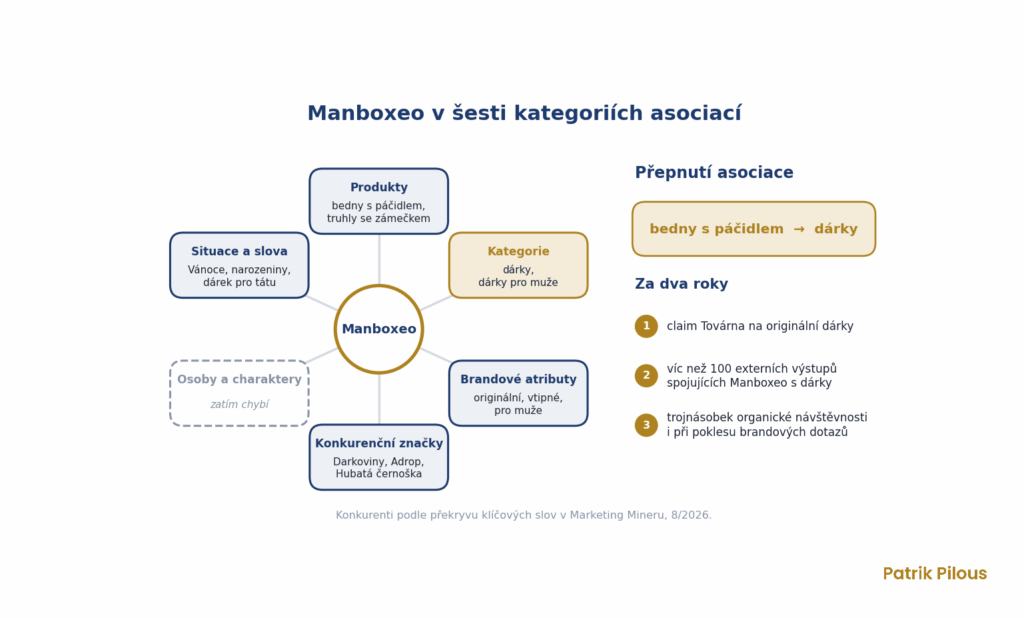
Five categories are covered, while people and characters remain empty. The brand has no face or character that people would remember, and this is also the cheapest place to gain something. I choose the competitors in the diagram based on keyword overlap in Marketing Miner, not on who the brand would like them to be.
How associations can be shifted
Associations are not fixed forever. With Manboxeo, we started with a strong link to crates opened with a crowbar. An interesting product, but a small market that constantly needs building.
According to Marketing Miner, the query “crate with a crowbar” (bedna s páčidlem) gets 230 searches a month on average, while “gifts for men” (dárky pro muže) alone gets 11,000, almost fifty times more, and in December 2025 it was 38,000 (Czech Republic, last 12 months, tool estimate). Gifts are also a category in which people buy repeatedly.
Over two years, the slogan Factory of Original Gifts was created, along with more than a hundred external pieces linking Manboxeo with gifts. Anchor texts did a lot of the work. Besides the brand name on its own, they also used the brand combined with what it offers, for example “Manboxeo, gifts for men”.
Organic traffic tripled over those two years, even though branded queries fell. When the total grows and branded traffic declines, the growth must have come from queries that do not contain the brand name at all. Several things changed on the website during that time, so I do not attribute all of the growth to associations. But the direction matches exactly what we were aiming for.
What to write in external texts is suggested by a study on generative engine optimisation from Princeton and other institutions. The visibility of a text in AI answers was boosted most by adding sources, quotations and statistics, by 30 to 40% in relative terms, while keyword stuffing barely helped. It is one study on its own set of queries, and applying it to brands is my own extrapolation. But according to it, a text with numbers and facts about the brand has a better chance of appearing in an answer.
Negative associations must be refuted
With Manboxeo, three doubts kept coming up. “It’s rubbish.” “It’s fake.” “It’s from China.” A doubt that the internet repeats and nobody refutes is one that AI will happily repeat too.
When AI says something negative about you and the answer shows its sources (Perplexity and ChatGPT search almost always show them), find out where it is getting it from and respond where people are talking about you.
- On your website, with a direct answer to every doubt. Who makes the product, from what and where.
- Among customers, with reviews and unboxing videos that show the real product.
- Externally, with external articles that tell the truth in their own words.
Fifty copies of one press release do not carry fifty times more weight, because near-identical texts in training data are often merged. Researchers from Google and the University of Pennsylvania showed how much repetition there can be in data. In the C4 dataset, they found a 61-word sentence that was repeated over 60,000 times, and after deduplication the models reproduced memorised text verbatim ten times less often.
That is why ten different websites saying the same thing in their own way carry more weight than one text sent to fifty addresses.
How to run a monthly association check
Once a month, ask ChatGPT, Gemini and Perplexity questions from all six categories and write down the answers. For each category, prepare five differently worded questions and enter each one several times in a new window. SparkToro had 600 volunteers enter 12 queries into three tools, 2,961 times in total. The same list of brands came back less than once in a hundred times, and in the same order less than once in a thousand.
What matters, therefore, is the share of answers in which the brand appears, not its position in any single one. (The research was done by SparkToro with the startup Gumshoe, which sells AI visibility measurement, so take it with a pinch of salt.)
In the monthly column of the table, record the share of answers that match your goal (for example 9 out of 30) and what was repeated in them. The table shows only the first question for each category.
| Category | Question for AI | What we want to be associated with | Month 1 | Month 2 | Month 3 |
|---|---|---|---|---|---|
| Products | What does X sell? | ||||
| Category | Where can I buy a gift for a man? | ||||
| Brand attributes | What is brand X like? | ||||
| Competing brands | What are the alternatives to X? | ||||
| People and characters | Who is behind X? | ||||
| Situations | What should I buy my dad for Christmas? |
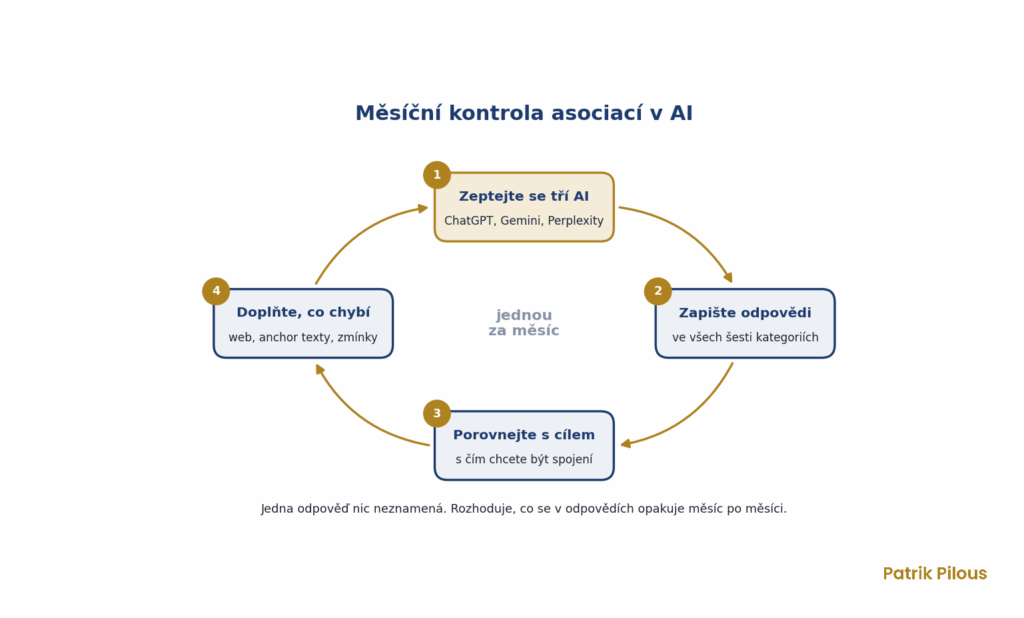
Compare the result with what you want to be associated with, and add whatever is missing to your website and to external mentions. You can manage this by hand for a few dozen queries, but beyond that it is better to measure with a tool that asks the prompts repeatedly and calculates the share of mentions. I use Marketing Miner for this.
How many answers you need for the numbers to mean something
You cannot tell a shift from chance with just a few answers. If AI mentions you in 15 out of 30 answers, that is 50%, but with 95% confidence the true value lies only somewhere roughly between 32 and 68%. The range narrows slowly, with the square root of the number of answers.
| Answers in one category | Range at a 50% share (in percentage points) | What shift between two months you can tell apart from chance |
|---|---|---|
| 10 | ± 31 | over 40 points, so almost none |
| 30 | ± 18 | roughly 25 points or more |
| 100 | ± 10 | roughly 15 points |
| 400 | ± 5 | roughly 7 points, this needs a tool |
Six categories, five questions in each, three models and two repetitions give 180 answers a month, which is 30 per category. So do not treat a change of less than roughly 25 points between two months as a shift, but as noise. The three models are combined in one number here, and you cannot compare them with each other based on ten answers each.
This is the worst case, around 50%, and the range is narrower for low shares. It also assumes the answers are independent of each other, which is only roughly true for repeated queries, so the real uncertainty tends to be larger.
Where to start with your brand
Entity first. Write that one sentence about the brand and make it consistent, along with the basic facts, on your website, in directories and on social media. On Wikidata, at least keep an eye on the facts. Until the entity is the same everywhere, associations have nothing to grow from.
Then associations. Measure all six categories, but work on only two or three where the gap between what AI says and what you want is largest and where it also matters most commercially. You cannot shift all six at once, and a budget split six ways will not move any of them.
| Week | What to do | What you have at the end |
|---|---|---|
| 1 | write one sentence about the entity and review the facts across sources | the sentence and a list of places to fix |
| 2 | fix the website and your own profiles, add Organization and sameAs | the same facts everywhere you control them |
| 3 | first measurement of all six categories | a baseline table |
| 4 | choose two or three categories with the biggest gap | a plan for content and external mentions |
With Manboxeo, it took two years for the shift from crowbar crates to gifts to show up in traffic. So evaluate results quarterly. A quarter also gives you 90 answers per category and a range of around 10 points, so you can read more from it than from a single month.
I describe how the rest of search work fits into this in the article How SEO and GEO work. If you would like me to look at your brand’s entity and associations, get in touch via the GEO, SEO for AI page.

