

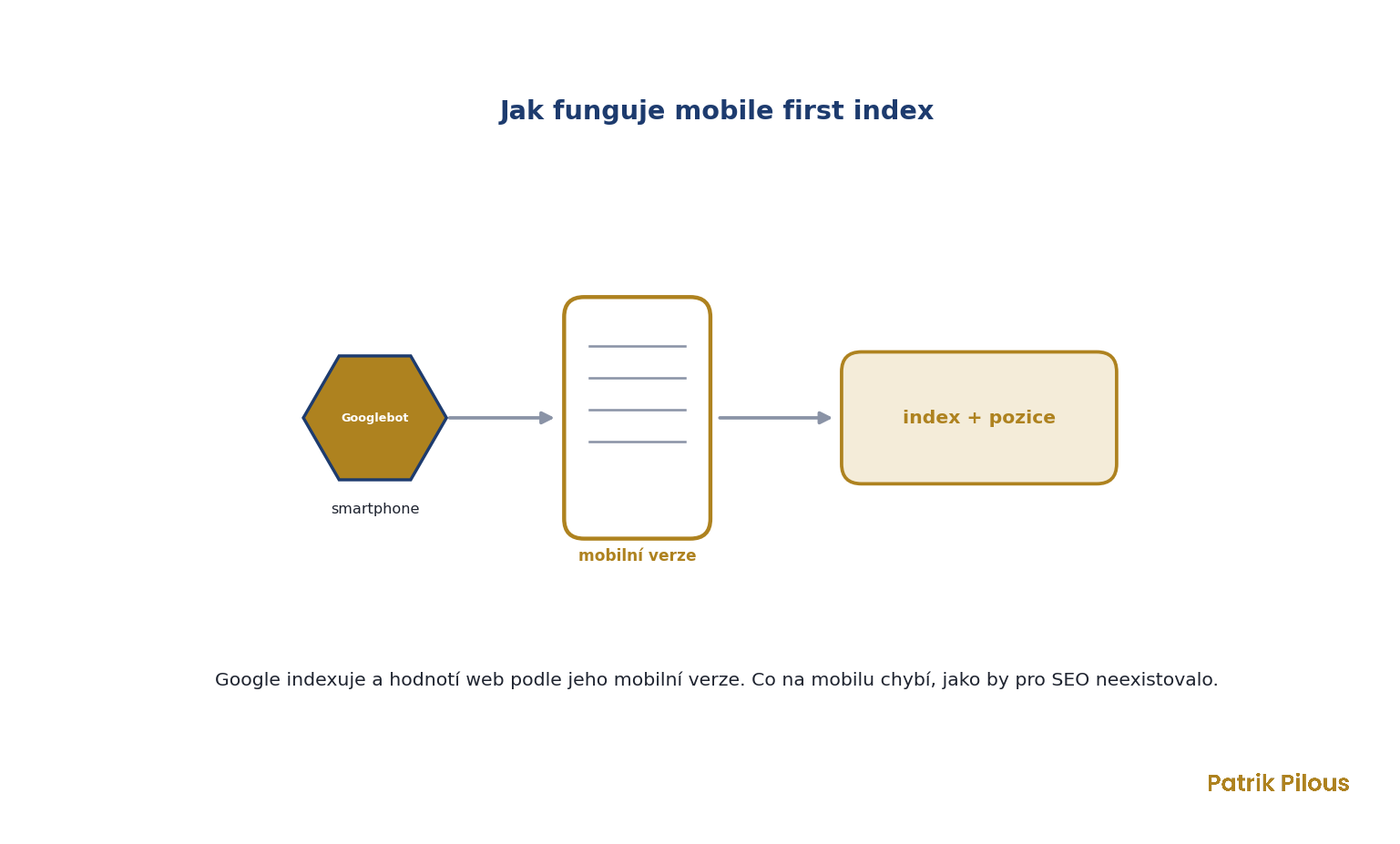
Mobile-first indexing is the way Google evaluates websites. It means that for both indexing and rankings, Google treats the mobile version of a site as decisive, not the desktop one. Put simply, Google looks at your website through the eyes of a phone. Anything missing or hidden on mobile is, as far as the search engine is concerned, as good as non-existent. This is not a future trend but a reality that has applied to the vast majority of websites for many years. For anyone who runs a website, the conclusion is clear. The mobile version is not a secondary variant of the desktop site but the main one, and it decides your visibility.
Where the term comes from
The phrase mobile first, meaning mobile in first place, comes from web design. It describes an approach where a website is designed first for the small screen of a phone and only then expanded to tablet and desktop. It reverses the original logic, when websites were built mainly for desktop and barely squeezed onto mobile. The word index refers to the search engine’s database. Mobile-first indexing therefore means the index is built from the mobile version, and it goes hand in hand with a good user experience.
A short history of mobile-first indexing
Google announced the move to mobile-first indexing in 2016 in response to a simple fact. By then, most searches were already happening on mobile phones, not on computers. It made no sense to evaluate websites based on the desktop version that only a minority of people saw.
The transition happened gradually over several years, and around 2023 it became the standard for practically all websites. Today it is the default, and it is reflected in how SEO works as a whole. A website without a working mobile version is essentially not competitive today.
How mobile-first indexing works from an SEO perspective
In practice, Googlebot crawls the website as a smartphone. What it finds on the mobile version during this crawling is the basis for both indexing and ranking. That is why it is crucial for the mobile version to contain the same content as the desktop version. The same text, headings, images and structured data.
The most common solution is a responsive website that adapts itself to the screen size. Speed and smoothness on mobile, which Google measures through Core Web Vitals, also matter a great deal, as does a clear site structure that is easy to navigate with a finger.
Why mobile-first indexing matters
If your mobile version shows less content than the desktop version, you lose rankings without knowing why. Hidden text, truncated descriptions or missing sections on mobile mean Google does not know about them, even if they are perfect on desktop.
Checking that the mobile and desktop versions match is therefore one of the basics of every technical SEO audit. And because most visits and purchases now happen on mobile, a poor mobile version costs you not only rankings but also conversions on your landing page.
Where it goes further
Mobile-first indexing is simply the technical reflection of how fundamentally our relationship with the internet has changed. We always have our phones at hand, and today we experience the web mainly through a small screen in our palm. Designing for mobile also forces humility and simplicity. On a small surface there is no room for anything unnecessary, so you have to focus on what matters. It is also linked to Fitts’s law, because a finger is less precise than a mouse, so buttons need to be large enough and easy to reach. Whoever thinks about mobile is ultimately thinking about people, and that holds true in the world of AI-powered search as well.
The most common mistakes
- Less content on mobile than on desktop, so Google misses part of the text when ranking.
- Overlooking mobile speed and poor Core Web Vitals on slower connections.
- Small, cramped buttons and links that are hard to tap on a touchscreen.
- Testing the website only on a large monitor without checking how it looks and is browsed on a phone.
Questions about mobile-first indexing
What is mobile-first indexing?
The way Google evaluates websites. For both indexing and rankings, it treats the mobile version of a site as decisive, not the desktop one.
Since when has mobile-first indexing applied?
Google announced it in 2016 and rolled it out gradually. Around 2023 it became the standard for practically all websites.
How do you prepare for mobile-first indexing?
Have a responsive website with the same content on mobile and desktop, fast loading on phones and clear navigation that works with a finger.

