
Core Web Vitals are a set of three metrics Google uses to measure how quickly and smoothly your website behaves from a real visitor’s point of view. Google does not ask how many kilobytes a page has. It asks how long a person waits for the main content, how quickly the site responds to a click and whether the layout jumps around under their hands.
Since 2021, Core Web Vitals have been one of Google’s ranking signals, so website speed is no longer just a matter of convenience and has become a direct part of SEO. Good scores help both rankings and conversions, while poor ones drive people away before they even read the first sentence. It is important to test on all the main devices. On the other hand, in my experience Core Web Vitals are not such a crucial metric if you are within the 80% fastest websites on the market.
Where the term comes from
The phrase Core Web Vitals can be translated as the key vital signs of a website. Google borrowed the word vitals from medicine, where it means vital signs, such as pulse, blood pressure and breathing, which a doctor measures first to find out how the patient is doing. Google applied the same logic to websites and to user experience: a few basic indicators that quickly reveal whether a page is healthy. The word core then stresses that these are the most important ones.
A short history of Core Web Vitals
Google was concerned with website speed long before Core Web Vitals arrived. It announced a speed signal back in 2010, and the PageSpeed Insights tool is even older. The turning point came in 2020, when Google introduced Core Web Vitals as a clear set of three metrics focused on real user experience. A year later, in 2021, they became part of the so-called Page Experience update and an official ranking signal. In 2024, one of the metrics changed. The original FID, which measured first input delay, was replaced by the more accurate INP. It is a similar shift towards real experience to the one I follow in how SEO and GEO are changing.
How Core Web Vitals work from an SEO perspective
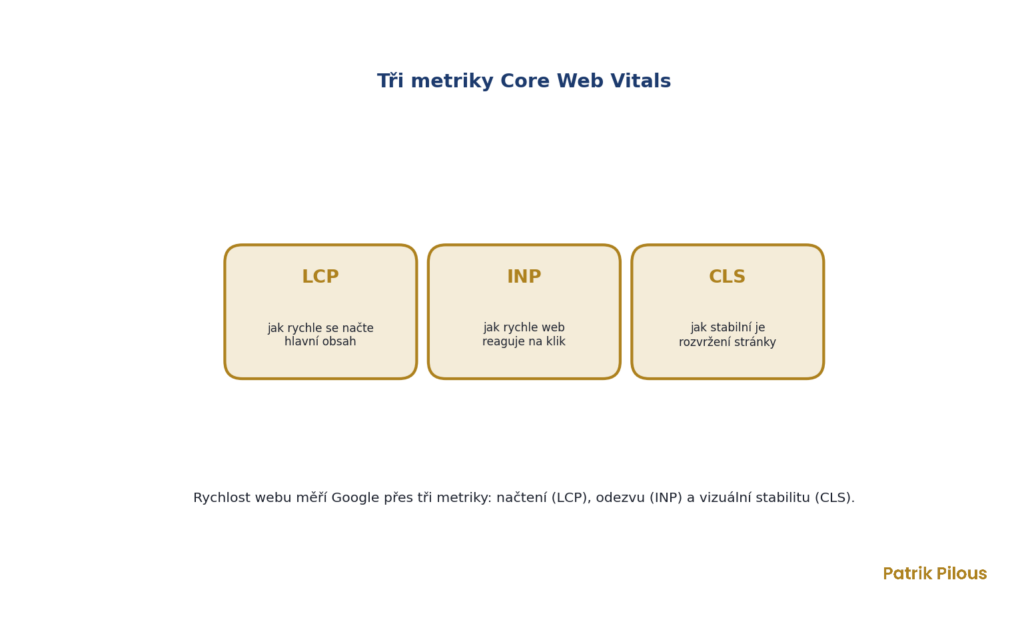
Google tracks three metrics.
- LCP (Largest Contentful Paint) measures how quickly the main content loads, ideally within 2.5 seconds.
- INP (Interaction to Next Paint) measures responsiveness to interaction, with a target of under 200 milliseconds.
- CLS (Cumulative Layout Shift) monitors visual stability and should not exceed 0.1.
The data come mainly from the real behaviour of Chrome users, not just from a lab test. Speed is a so-called tie breaker. Of two pages with comparable content, it helps the faster one rank higher, but even the best scores will not save weak content. Measuring and fixing them is therefore part of a regular SEO audit, and on WordPress it is most often handled with dedicated plugins, image optimisation, caching and fewer scripts. A slow website also slows down indexing, because the crawler gets through fewer pages in a given time.
Why Core Web Vitals matter
Speed affects revenue before it affects rankings. Every extra second of loading time increases the share of people who leave and lowers conversions on a landing page. In my view, this is even more important from an overall perspective. If colleagues or other people complain that the website is slow, pay attention and deal with it. If one of the metrics is only slightly flagged, definitely do not treat it as priority number one.
This is where SEO meets user experience. A jumping layout, measured by CLS, is exactly the moment when you want to click a button and it moves away from under your finger, which also relates to Fitts’s law on target accessibility. Leaving a slow website hurts twice, because loss aversion is at work in our heads. We feel a lost visit more strongly than one we never had.
Where it goes further
Behind three technical abbreviations lies a simple truth about human attention. Waiting annoys us and unpredictability makes us nervous. Personally, I hate queues, traffic jams and slow websites (especially when they have one of those fake loading elements).
A website that responds instantly feels trustworthy because it meets the expectations we are used to from other sites, as described by Jakob’s law. Speed also increases so-called processing fluency, the feeling that the content is easy to work with, and that alone raises trust and the willingness to stay. Core Web Vitals are really just a way of turning this impatience with waiting into numbers that can be measured and improved.
Most common mistakes
- Optimising only for the lab score in PageSpeed Insights instead of real user data.
- Chasing a score of 100 at all costs, even though visitors cannot tell the difference between 80 and 100.
- Unset dimensions for images and ads, which make the layout jump and worsen the CLS metric.
- Believing that a fast website will push weak content up on its own. It will not, because content and how it is presented also matter.
Questions about Core Web Vitals
What are Core Web Vitals?
A set of three Google metrics that measure the experience of a website’s speed and smoothness: LCP (loading of the main content), INP (responsiveness to interaction) and CLS (visual stability).
Are Core Web Vitals a ranking signal?
Yes, they have been part of the ranking since 2021. However, they act more as a tie breaker between comparable pages than as a main factor, which an audit will also confirm.
How do I measure Core Web Vitals?
The quickest way is Google PageSpeed Insights or the report in Search Console, where you can see real data from visitors to your website.

