

The negativity effect (negativity bias) is a cognitive bias in which negative information, experiences and emotions affect us far more strongly than positive ones of the same size. We remember one insult longer than ten compliments, one bad experience with a company outweighs many good ones, and one critical review catches our attention more than five enthusiastic ones. It is neither weakness nor pessimism but a deeply rooted defence mechanism. Our ancestors who paid more attention to threats than to pleasant things simply survived more often. In marketing, reputation and content creation this has a huge impact, because a single negative slip can wipe out a lot of good work.
Classification
- Cause (Cognitive Bias Codex): Too much information
- Mental area: Perception and emotions
- Marketing function: Reputation and content
- Buyer journey: across all stages (trust and decision-making)
- Cialdini’s principles: not applicable
- System 1 / System 2: System 1 (fast, automatic)
In a nutshell
- What it is: the negative weighs more in our perception than the equally large positive.
- Why we do it: noticing threats was more advantageous in evolutionary terms than noticing pleasant things.
- Where you will meet it: reviews, brand reputation, headlines, news.
- How to use it: watch out for mistakes and negative reviews; the good matters less than the absence of the bad.
A real-life story
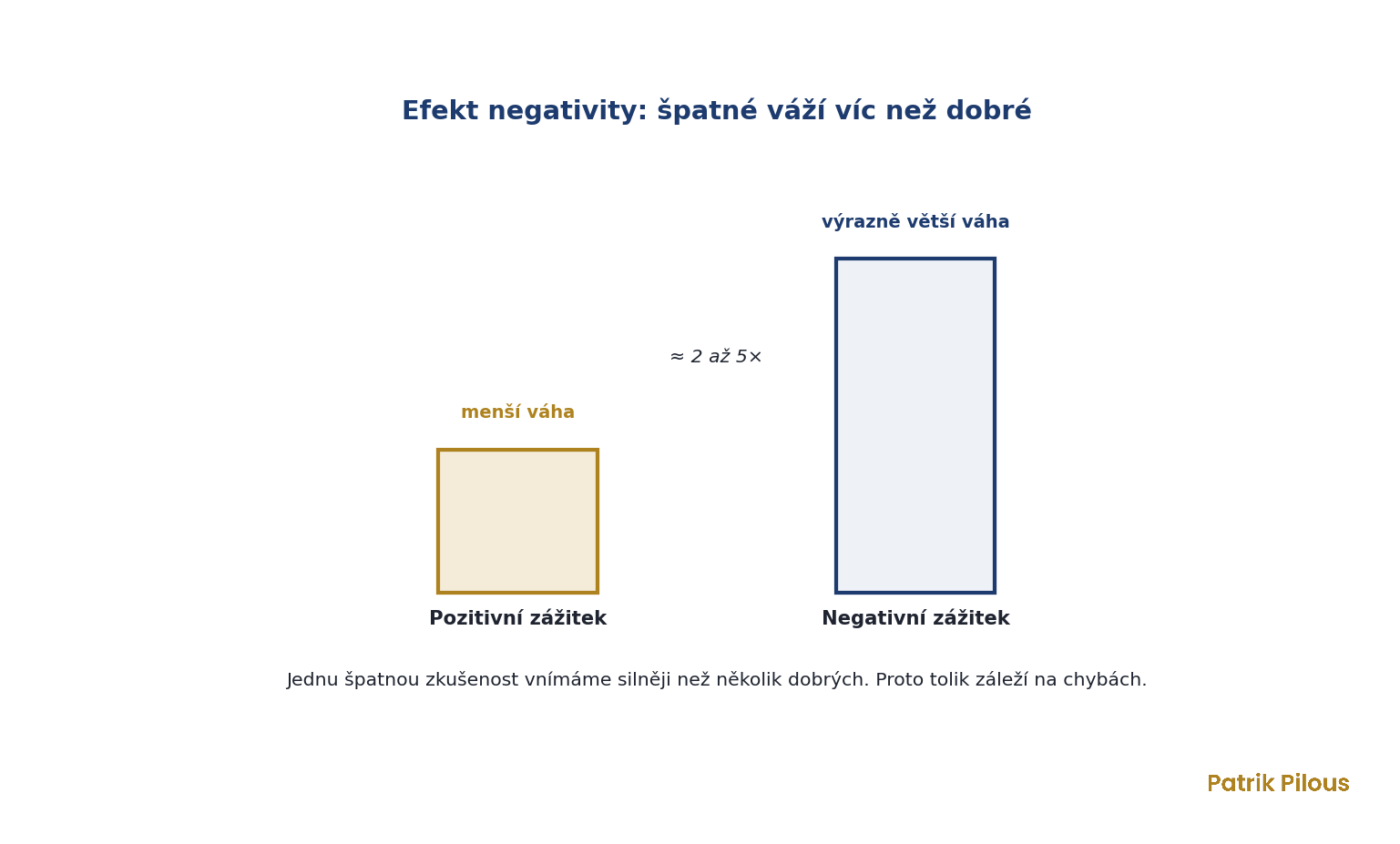
In 2001, psychologist Roy Baumeister’s team summed it up in the title of a scientific paper that says it all: Bad Is Stronger Than Good. Across disciplines, they found that negative events, emotions and feedback have a greater and longer-lasting impact on people than equally strong positive ones. Estimates vary, but it is often said that a negative experience weighs roughly two to five times more than a positive one.
The media have always known this. The journalistic rule “if it bleeds, it leads”, meaning that bloody stories draw readers, is not cynicism but a use of the negativity effect. Bad news simply attracts more attention. And you know it as a customer too. When you have ten great experiences with an online shop and one terrible one, it is mainly that one you remember, and you might move to a competitor because of it. One slip outweighs years of good service.
How the negativity effect works
The brain gives priority to negative stimuli because a threat could mean life or death, whereas a missed pleasure is merely a disappointment. We therefore process negative information faster, pay more attention to it and store it deeper in our memory. The effect is linked to loss aversion, because there too the bad (a loss) hurts more than the equally large good (a gain), and to confirmation bias, because once a bad impression has formed, we confirm it more easily.
Use in marketing
- Protect your reputation. One bad experience can do more harm than ten good ones do good. Preventing problems pays off more than loud praise.
- Respond to negative reviews quickly. A bad review draws attention. A quick and polite response often saves the impression more than the star rating itself. This is related to social proof.
- Actively collect positive reviews. Because one negative review weighs more, you need more positive ones to balance it out. Ask satisfied customers to leave a rating yourself.
- Headlines and CTR. Headlines that warn or name a problem (“5 mistakes that are costing you customers”) tend to get more clicks. Use this ethically, not as clickbait. More in the article on advertising slogans.
- Frame it as a loss. “Stop losing customers” works more strongly than “gain customers”, because it works with fear rather than with a vision.
- Take care of the last impression. One bad moment at the end of a purchase outweighs a nice beginning. Watch over complaints, delivery and after-sales communication, where PR also plays a part.
Negativity in reviews, why one bad review hurts
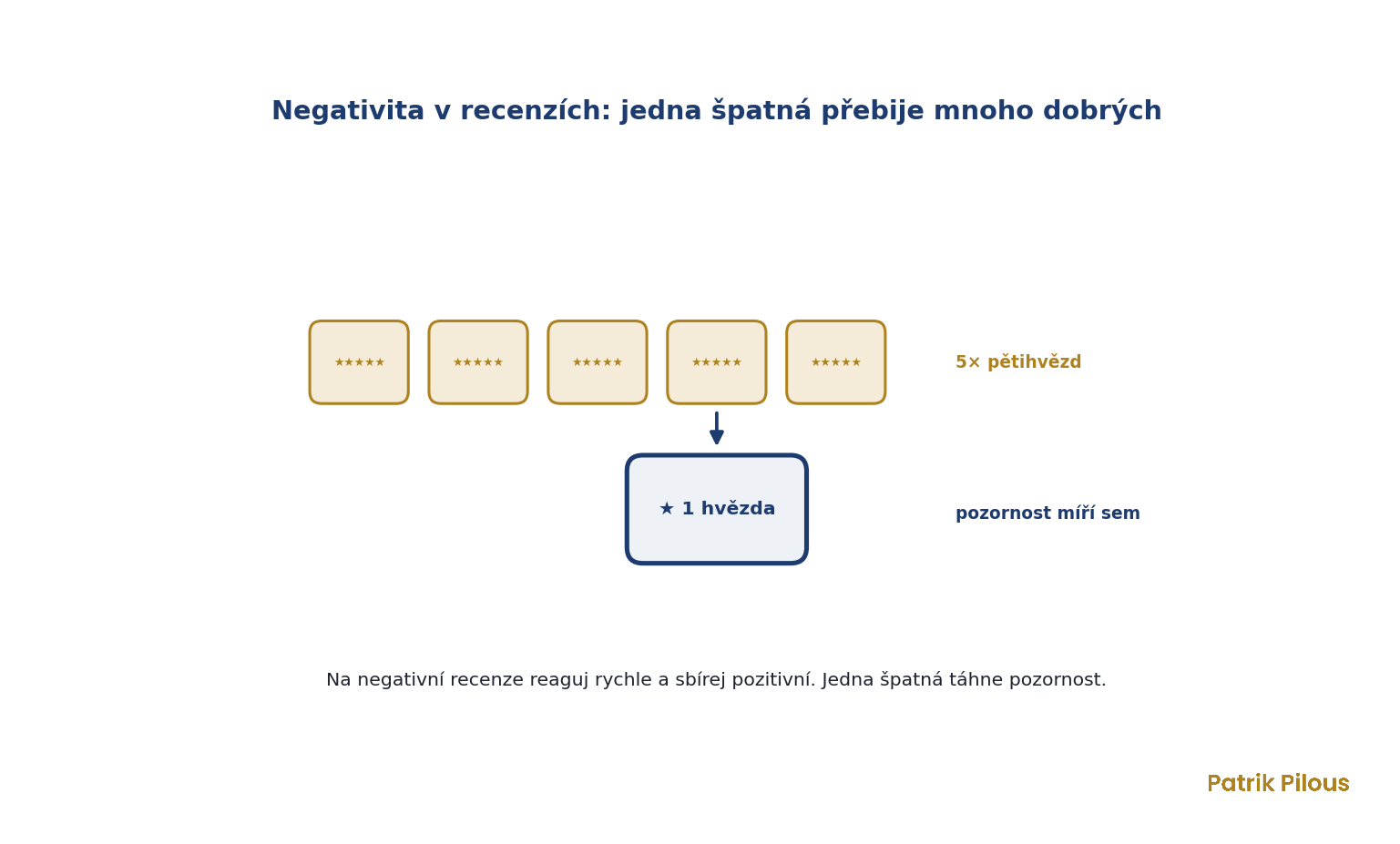
The negativity effect is most visible in online reviews, which today decide purchases almost everywhere. A customer browsing ratings subconsciously stops at the very worst one. A single one-star review among nothing but five-star ones attracts disproportionately more attention, and the reader spends more time on it than on all the praise put together. This does not mean you should fear the worst, but you should take negative feedback seriously and work with it.
How to protect yourself from the negativity effect
- Consider the ratio. Ask yourself whether one negative experience really outweighs many good ones, or whether it is just louder.
- Do not overrate criticism. Feedback is valuable, but a loud dissatisfied voice is not necessarily the majority.
- Be careful with the news. The world seems worse than it is, because bad news draws attention. Keep that in mind.
How it interacts with other biases
The negativity effect works mainly together with loss aversion and social proof. Take an online shop’s ratings. One bad review (negativity) makes you fear that you could lose out like that dissatisfied customer (loss aversion), and because it is someone else’s experience, it also works as social proof, just in a negative direction. And once a bad impression has formed, confirmation bias simply keeps confirming it. That is why it pays to give every piece of negativity above-standard care. You will find more connections in the encyclopaedia of cognitive biases.
Frequently asked questions
What is the negativity effect?
A cognitive bias in which negative information and experiences affect us more strongly and stay in our memory longer than positive ones of the same size.
Why is the negative stronger than the positive?
For evolutionary reasons. Noticing threats was more important for survival than noticing pleasant things, and this tendency has stayed with us.
How do you handle the negativity effect in marketing?
Protect your reputation and watch out for mistakes, respond quickly to negative reviews and actively collect positive ones, because one bad review weighs more than several good ones.

