
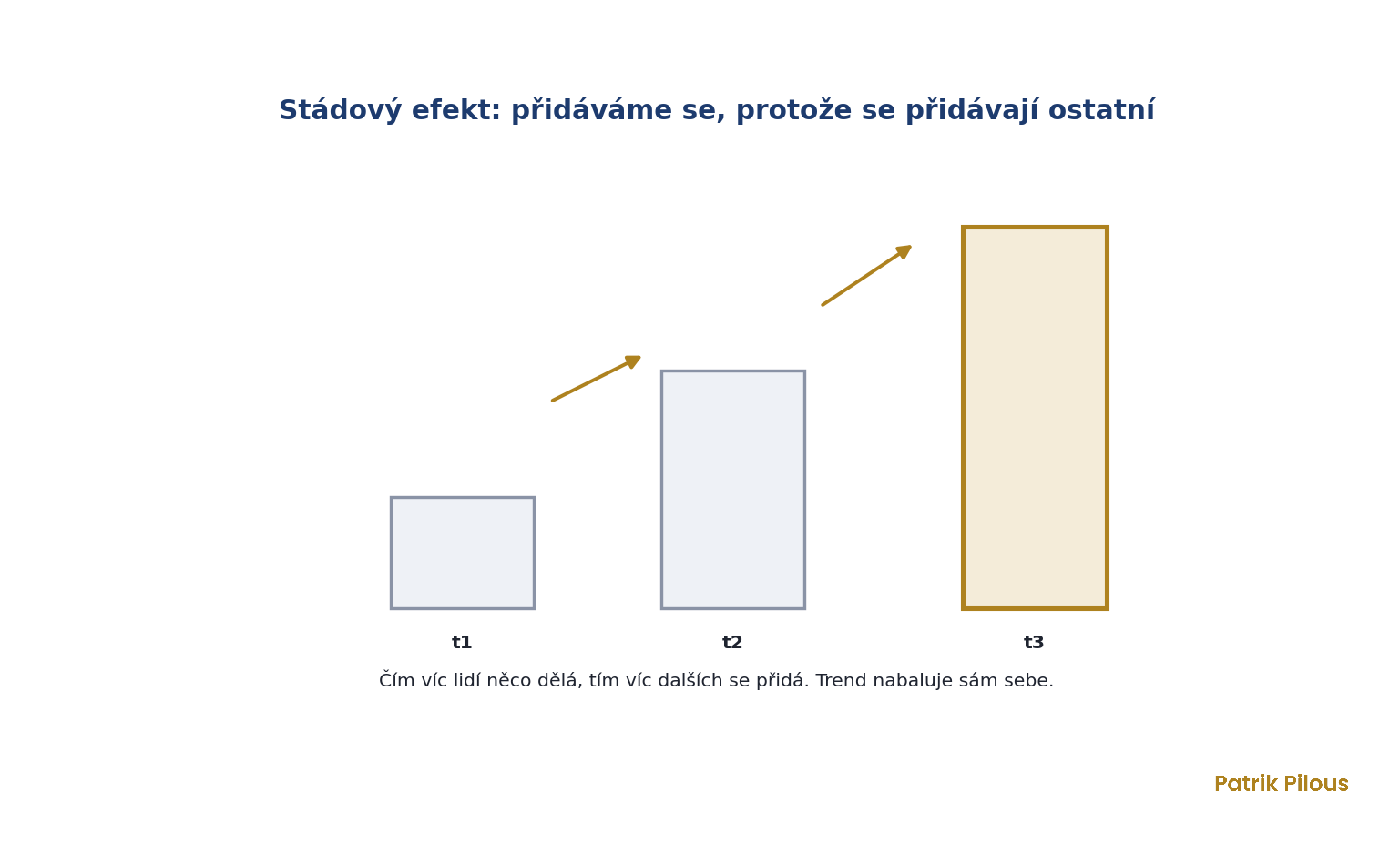
The bandwagon effect is a cognitive bias in which we adopt opinions, behaviours or purchases simply because more and more other people are doing the same, even when logic does not directly tell us to. The more people join something, the greater the pressure to join as well, so the trend snowballs on its own. It is not just that we believe the crowd is right. There is also a desire to belong and a fear of being left out. That is exactly why fashions, viral products and opinions spread so quickly once they pass a certain threshold of popularity.
Classifying the cognitive bias
- Cause (Cognitive Bias Codex): Not enough meaning
- Mental domain: Social
- Marketing function: Social influence
- Buyer journey: Consideration and decision
- Cialdini’s principles: Social proof
- System 1 / System 2: System 1 (fast, automatic)
In a nutshell
- What it is: we join something because others are joining.
- Why we do it: we want to belong to the majority and not be left out.
- Where you will meet it: trends, viral products, “bestsellers”, crowd enthusiasm.
- How to use it: show growing popularity and momentum, not just a static number.
A real-life story
The English name “bandwagon effect” comes from 19th-century American political parades. Candidates rode on a decorated wagon with a band, and to jump on the bandwagon meant joining the winning side regardless of its programme. In 1950, the economist Harvey Leibenstein formally described the bandwagon effect as a situation in which demand for a product rises simply because others are buying it.
You know it from fashion and technology. Once enough people around you start using a particular shoe, app or TV series, even those who originally had no interest join in, just so they are not left out. And in elections you can often see that some people lean towards supporting the favourite who leads in the polls, precisely because they are leading.
How the bandwagon effect works
The bandwagon effect rests on two needs. The first is practical. When we do not know what to do, we follow the crowd, because others may know something we do not. That is the core of social proof. The second is emotional. We want to belong and not be the ones left out, which is also linked to FOMO. The difference from plain social proof lies in movement. With the bandwagon effect, it is not just that many people are doing something, but that their number is growing fast.
Use in marketing
- Show growth, not just numbers. “5,000 people joined us this month” feels stronger than a static number, because it shows momentum.
- Bestsellers and trends. Labels such as “bestseller” or “trending now” trigger the urge to join in.
- Visible popularity. Numbers of shares, downloads and users make a trend tangible.
- Kick-start with the first wave. At the beginning, help the trend get going, for example through a community and ambassadors, so that it passes the critical threshold.
- Live signals. “X people are buying this right now” shows the crowd moving in real time.
How to resist the bandwagon effect
- Separate popularity from quality. Just because lots of people buy something does not mean it is the best for you.
- Decide for yourself. Ask yourself whether you would want it even if nobody else had it.
- Watch out for artificially inflated trends. Not every crowd is real. Sometimes it is just well paid.
How it connects with other biases
The bandwagon effect is essentially a dynamic version of social proof. Social proof says we do what others do. The bandwagon effect adds that we are all the more likely to join the faster others are joining. Add FOMO, the fear of missing out on something that is currently all the rage, and you get a powerful combination that drives viral growth. You can see it clearly with sold-out events, where an “almost sold out” sign combines the crowd’s growing interest with the fear of missing out.
Frequently asked questions
What is the bandwagon effect?
A cognitive bias in which we adopt opinions or purchases because more and more other people are doing the same, so the trend snowballs on its own.
What is the difference between the bandwagon effect and social proof?
Social proof rests on the fact that many people are doing something. The bandwagon effect also emphasises momentum, meaning that their number is growing fast.

