
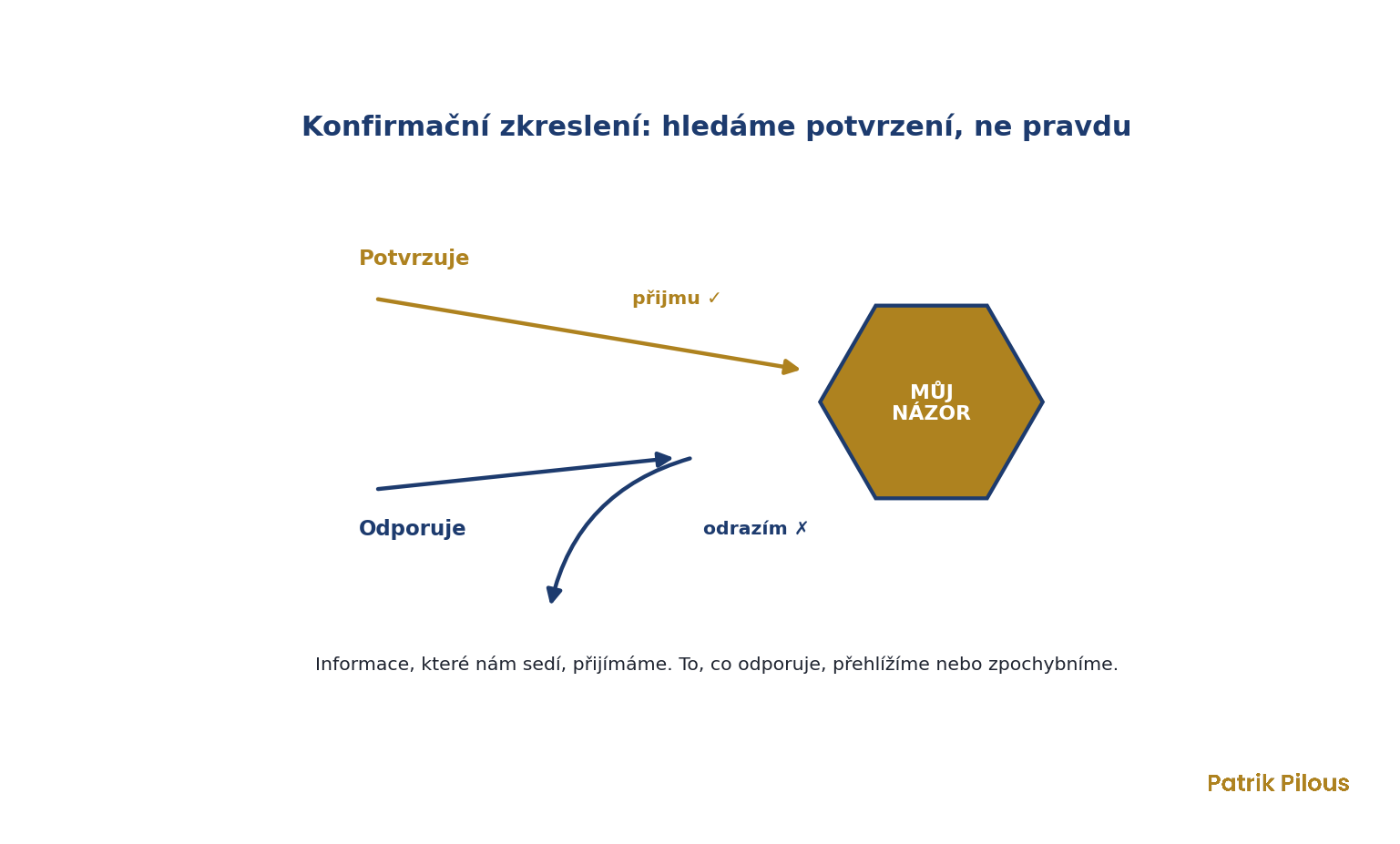
Confirmation bias (in Czech also known as potvrzovací zkreslení) is a cognitive bias that makes us seek out, remember more easily and trust more strongly information that confirms what we already think. Evidence that goes against our view, on the other hand, we overlook, play down or dismiss outright. This is not stupidity or bad intent. Our brain is simply trying to save energy and keep us at peace, and a world that proves us right is more comfortable for that. The result is that we look for confirmation, not the truth. And the more information there is around us, the easier it is to pick only the bits that suit us.
Classification of the cognitive bias
- Cause (Cognitive Bias Codex): Too much information
- Mental area: Beliefs and judgement
- Marketing function: Ego and beliefs
- Customer journey: Consideration
- Cialdini’s principles: not applicable
- System 1 / System 2: System 1 (fast, automatic)
In short
- What it is: we look for and believe what confirms our view, and reject the rest.
- Why we do it: the brain saves energy and does not want to admit it was wrong.
- Where you will meet it: choosing reviews, political debates, social media and their bubbles, judging your own work.
- How to use it: confirm what customers already think about themselves and their decision.
A real-life story
This is not a new discovery. As early as 1620, the English philosopher Francis Bacon wrote that once a person adopts an opinion, they draw everything else in to support it, and even when there is more and stronger evidence against it, they either fail to notice it or set it aside. That is exactly confirmation bias, described four hundred years before it got its name.
It was demonstrated scientifically by the British psychologist Peter Wason. In 1960 he gave people a number sequence puzzle and asked them to uncover the hidden rule. Most participants formed a hypothesis and then only tried examples that confirmed it, instead of trying ones that might disprove it. That is precisely why they often failed to find the rule. People were not testing, they were proving to themselves that they were right.
Imagine Linda choosing a new washing machine. She already has a favourite in mind. She opens the reviews, but she does not read them all the same way. She nods along and reads carefully the ones that praise her choice. She skims the critical review and thinks to herself, “he probably just couldn’t connect the hose”. The decision was made long before, and the reviews only serve to justify it.
Did you know: social media multiplies confirmation bias. The algorithm mainly shows you content you agree with, because that is what you react to. This creates an information bubble in which it seems that “all sensible people” see the world the same way you do. The illusory truth effect is closely related, because repeated content we agree with also sounds truer to us.
How confirmation bias works
It works on two levels. First, it affects what information we look for in the first place. We type questions into a search engine expecting a particular answer. Second, it changes how we evaluate information. We take supporting evidence for granted and look for flaws in contradicting evidence. In a frequently cited review from 1998, the psychologist Raymond Nickerson concluded that confirmation bias is so widespread and strong that, in his view, it lies behind a large share of the disputes, myths and poor decisions in human history. It is connected to how we notice only things that already remind us of something, which is close to priming, and to how we more readily believe people and brands we already know, see the mere exposure effect.
Use in marketing
- Confirm the customer’s self-image. People buy what fits the image they have of themselves. Show that your product belongs to “people like you”.
- Reviews and social proof. A customer who is already leaning towards buying looks for reasons why it is a good decision. Have them ready in the form of reviews and testimonials. This links to social proof.
- Targeting and segmentation. Speak to each group in the language of its beliefs. A message that confirms the audience’s values gets through more easily than one that challenges them.
- Content that proves people right. Articles and videos that confirm what readers already think are shared the most. But watch out for the trap of merely reinforcing bubbles instead of being useful.
- Reducing post-purchase doubt. After buying, customers look for confirmation that they chose well. A thank-you email along the lines of “great choice” meets this need and reduces returns.
- Framing questions and surveys. The question “why do you like our product” collects different data from a neutral question. Be aware of this so that you do not end up collecting only confirmation yourself.
How to protect yourself from confirmation bias
- Look for opposing evidence. Deliberately ask yourself, “what would have to be true for my view to be wrong?”. This reverses the natural direction of your thinking.
- Read the criticism too. When making a decision, consciously seek out the best counterarguments, not just praise. The strongest person is the one who can also argue the other side.
- Be careful with your own data. When you measure results, ask yourself whether you are only collecting the numbers that confirm what you want to hear.
Confirmation bias is the silent guardian of our opinions. As a marketer, you can use it by confirming the customer’s choice. As a person, the only way to protect yourself from it is to consciously look for reasons why you might be wrong.
Frequently asked questions
What is confirmation bias?
A cognitive bias in which we look for and believe information that confirms our view, and overlook information that contradicts it.
What is an example of confirmation bias?
Reading reviews before a purchase, paying close attention to praise for our favourite and brushing off criticism, or the information bubble on social media.
How can you protect yourself from confirmation bias?
Consciously look for opposing evidence and the best counterarguments, and ask what would have to be true for our view to be wrong.

