

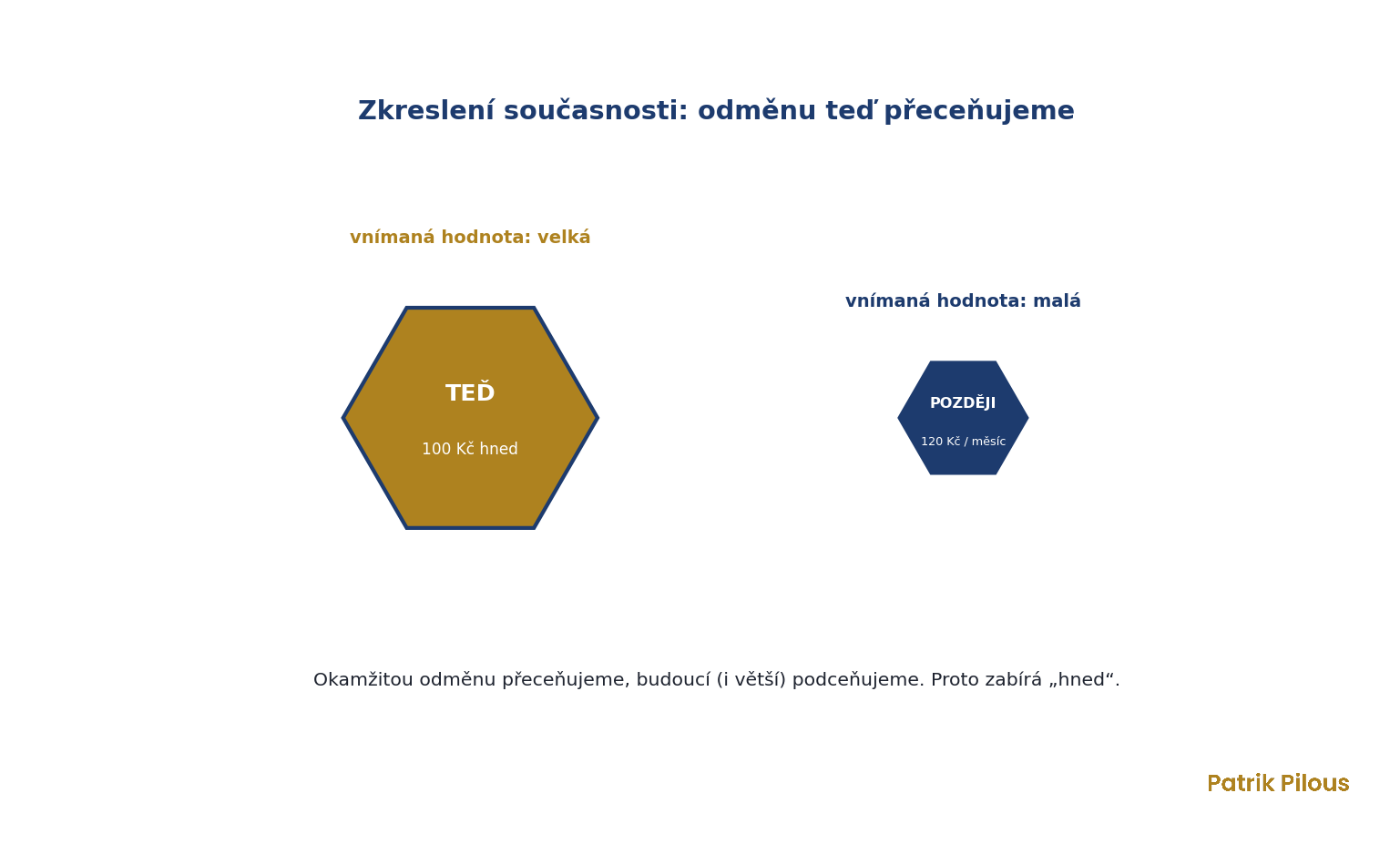
Present bias, linked to so-called hyperbolic discounting, is a cognitive bias in which we greatly overvalue an immediate reward compared with a future one. What we can have right now seems more valuable than something better that we would have to wait for. That is why we prefer 100 CZK (about 4.1 EUR) now to 120 CZK (about 4.9 EUR) in a month, sweets now to being slim in a year, and a one-click purchase to saving money. Our decisions are driven not by reason but by impatience. A large part of marketing is built on exactly this impatience, from urgency tactics and deferred payment to instant delivery.
Classification
- Cause (Cognitive Bias Codex): The need to act fast
- Mental area: Decision-making and emotional
- Marketing function: Price and value, scarcity
- Buyer journey: Decision
- Cialdini’s principles: not applicable
- System 1 / System 2: System 1 (fast, automatic)
In brief
- What it is: we overvalue immediate rewards and undervalue future ones.
- Why we do it: impatience and a tendency towards instant gratification.
- Where you’ll see it: deferred payment, urgency, instant delivery, “buy now”.
- How to use it: offer an immediate benefit and push the cost into the future.
A real-life story
The most famous evidence of our impatience came in 1972 from psychologist Walter Mischel at Stanford, in the so-called marshmallow test. He gave children a choice: one sweet now, or two if they could wait fifteen minutes without eating the first one. Most young children could not resist the immediate temptation. Later research into hyperbolic discounting, which economists George Ainslie and Richard Thaler also built on, showed that we carry the same impatience into adulthood, we just hide it better.
You know this yourself. “Buy now, pay later” works because you get the joy of buying straight away, while the pain of paying lies somewhere in the hazy future. In the same way, a sale countdown or next-day delivery aims to spare you the wait. And the resolution to start saving or exercising next month usually loses to whatever today offers, because we simply undervalue future rewards.
How present bias works
Our valuation of a reward drops sharply over time, and unevenly. We perceive the difference between “now” and “in a week” as huge, while we barely notice the difference between “in a year” and “in a year and a week”. It is precisely this uneven, hyperbolic drop in value that makes us decide short-sightedly. The bias is linked to the fear of missing out and the scarcity principle, because time pressure pushes us to act now, and to loss aversion, because we treat waiting as losing immediate pleasure.
Use in marketing
- Immediate benefit. Stress what the customer gets straight away. “Download and use it instantly” works better than a delayed benefit.
- Deferred payment. “Buy now, pay later” gives joy now and pushes the cost back. That is why more and more e-shops offer it.
- Fast delivery. Same-day or next-day delivery turns impatience into a competitive advantage.
- Time urgency. Countdowns and “today only” play on the fact that we don’t want to wait or miss out on a deal. This ties in with scarcity.
- Small steps now. When the first step is immediate and easy, people take it. A well-set default option helps too.
- Instant reward for action. A discount, gift or access right after sign-up works better than a reward promised for the future.
The other side of the coin, hyperbolic discounting
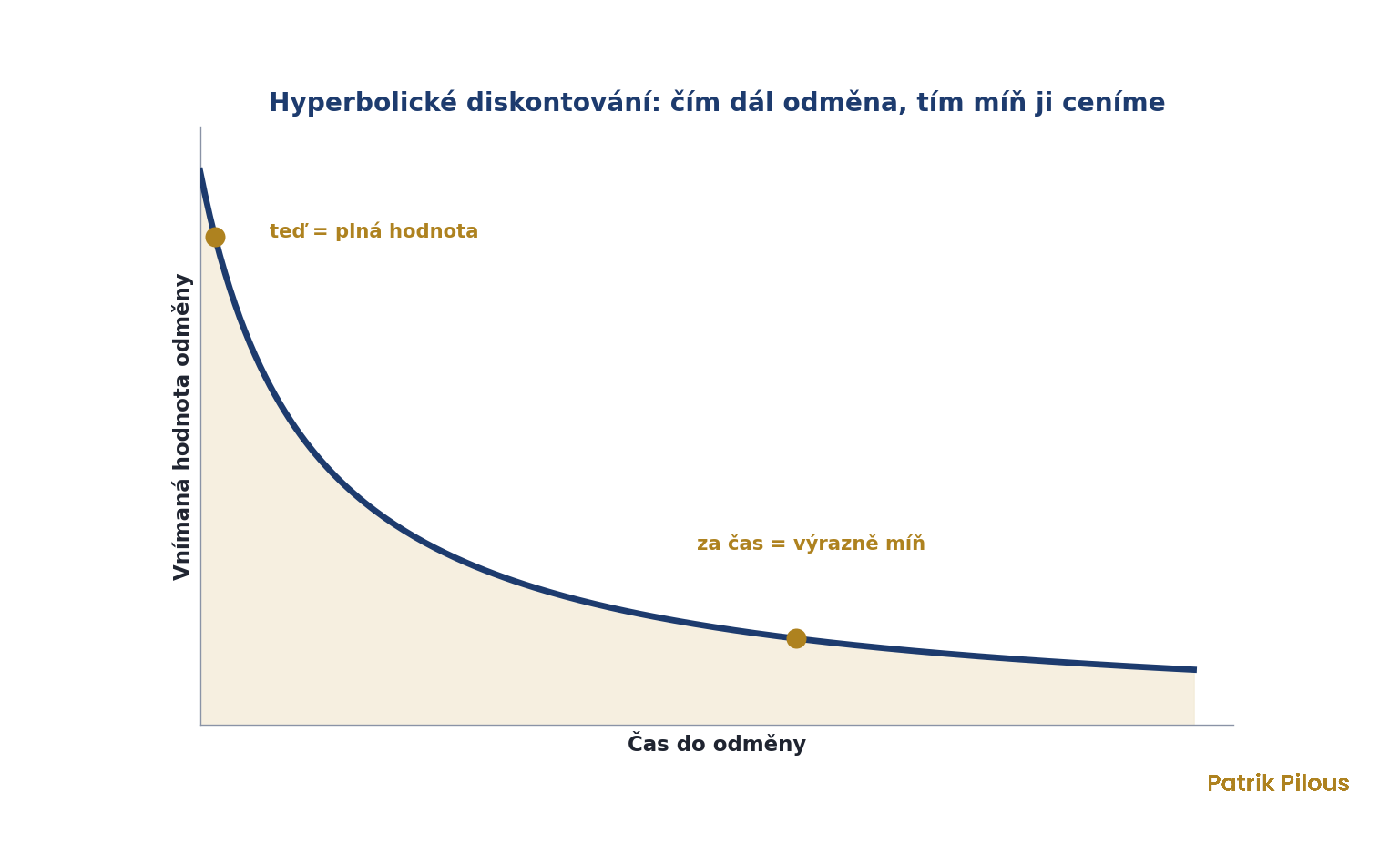
To see why “now” wins so reliably, it helps to look at the curve of a reward’s value over time. It is not a smooth slope but a steep drop right at the start. Anything we have to postpone, even slightly, loses a lot of value in our eyes. Marketing turns this curve to its advantage by placing the pleasure at its steep beginning and pushing the cost into its flat part.
How to protect yourself from present bias
- Take a break. An artificial “now” aims at immediate action. Postpone the decision by a day and the impatience fades.
- Think of your future self. Ask whether you in a month will also welcome the decision, not just you right now.
- Beware of deferred payment. The joy comes now, the instalments come later. Factor in the total price.
How it interacts with other biases
Present bias is an engine powered by related biases. Take the offer “last items, buy now, pay in a month”. Time pressure triggers FOMO and the scarcity principle, the instant joy of buying against a deferred payment is pure present bias, and the reluctance to miss a good price is loss aversion. If the first month is also free, the zero price effect joins in. Together they create an offer that is hard to resist.
Frequently asked questions
What is present bias?
A cognitive bias in which we overvalue an immediate reward compared with a future one, even when the future one is objectively larger. It is related to hyperbolic discounting.
What is hyperbolic discounting?
The way the value of a reward falls in our eyes over time. The decline is not even but steep right at the start, which is why we decide short-sightedly.
How can present bias be used in marketing?
By offering an immediate benefit and pushing the cost into the future, for example through deferred payment, fast delivery and time urgency.
Euro amounts are approximate, converted at the Czech National Bank rate of 24.34 CZK per EUR on 29 October 2026.

