
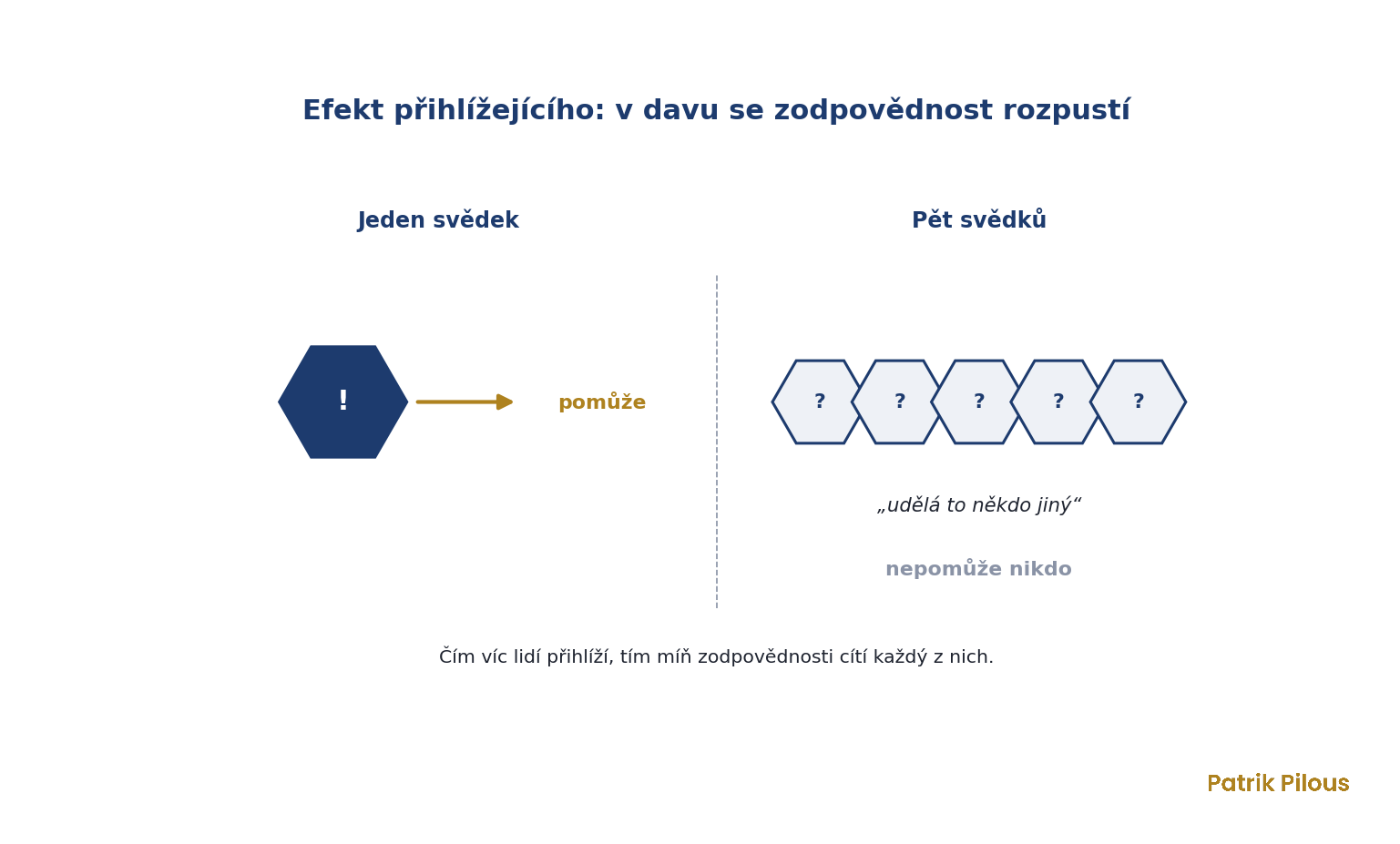
The bystander effect (efekt přihlížejícího) is a psychological phenomenon in which the more people witness a situation, the smaller the chance that any of them will step in and help. Sounds illogical, doesn’t it? You would expect more people to mean a better chance of help. But it is the other way round. Responsibility dissolves in a crowd, everyone relies on someone else to act, and the result is that nobody acts. This effect does not only apply to dramatic accidents but also to completely everyday things, including why your call to action on your website gets no response.
Classifying the cognitive bias
- Cause (Cognitive Bias Codex): Not enough meaning
- Mental domain: Social
- Marketing function: Social influence
- Customer journey: Action (call to action)
- Cialdini’s principles: not applicable
- System 1 / System 2: System 1 (fast, automatic)
In a nutshell
- What it is: the more bystanders, the less willingness to help or act.
- Where you meet it: unaddressed appeals, mass emails, “let someone else do it”.
- How to use it: address specific individuals, not the crowd.
A real-life story
The best-known and also saddest story took place in 1964 in New York. A young woman named Kitty Genovese was attacked and murdered near her home. According to the original reports, many neighbours heard or saw the attack, and yet for a long time nobody called the police. (Later findings refined those numbers and showed that the situation was more complicated, but the case became a symbol and launched decades of research.) The question was this: how is it possible that the more people see something, the fewer of them help?
The answer came from psychologists John Darley and Bibb Latané. In one experiment, they had a participant sit in a room that began to fill with smoke. When the person was alone, they usually went quickly to report the problem. But when other people (planted actors) were sitting in the room and calmly stayed seated, most participants also did nothing and just waited. Their sense of responsibility dissolved, and on top of that, the calm of the others led them to conclude that nothing was probably wrong.
You know it from everyday life too. When an email addressed to “everyone” arrives at work asking for help, usually nobody responds. But write the same request to one person by name and you will almost always get a reply. That is the bystander effect on a small scale.
Fun fact: this is exactly why first aid courses teach you not to shout “call an ambulance” into a crowd but to point at a specific person: “you in the blue T-shirt, call 155”. Addressing someone directly breaks the bystander effect instantly, because the responsibility no longer has anywhere to spread.
Bystander effect examples from everyday life
You do not need a dramatic emergency to see the bystander effect at work. It shows up wherever many people see the same problem and nobody owns it.
- The group chat. Someone asks the group a question and nobody answers, because everyone assumes someone else will.
- The broken car on the motorway. Hundreds of drivers pass a stranded car, and each assumes that someone has already called for help.
- Online harassment. Many people see an unpleasant comment under a post, but few report it or speak up.
- The shared office kitchen. The dishwasher stays full for days because it belongs to everyone, which means it belongs to nobody.
- The meeting without an owner. Everyone agrees on next steps, nobody is named, and a week later nothing has happened.
- A known bug in a product. Several colleagues notice it, but each assumes it has already been reported.
How the bystander effect works
Two mechanisms lie behind it. The first is diffusion of responsibility: the more people there are, the smaller the share of responsibility that falls on each individual. The second is so-called pluralistic ignorance, where everyone takes their cue from the behaviour of others. When nobody reacts, we take it as a signal that the situation is not serious, and we do not react either. It is close to social proof, just in its passive, paralysing form. The authority effect also plays a role, because if one person takes the lead, the others often join in.
The five steps before anyone helps
Latané and Darley later described helping as a sequence of decisions. A bystander has to pass through all of them, and the crowd can stop them at any step.
- Notice the event. In a busy place, you may simply not see it.
- Interpret it as a problem. If others look calm, you read the situation as harmless.
- Accept responsibility. This is where diffusion of responsibility hits hardest.
- Know how to help. If you are unsure what to do, you hesitate.
- Decide to act. Fear of looking foolish in front of others can still hold you back.
The same steps apply to a visitor on your website. They have to notice your request, understand that it is meant for them, feel it is their move, know exactly what to do and feel comfortable doing it.
Use in marketing
- Address individuals, not the crowd. “You” works better than “all of you”. A personalised call to action gets a significantly higher response than an unaddressed one. On LinkedIn, people tag specific individuals.
- One clear call to action. When you put five buttons on a page, responsibility for the decision gets diffused. One specific CTA leads to action better.
- A specific appeal for charity. “Help Adélka” with a face and a story works many times better than “help those in need”. One specific story beats an abstract crowd.
- Emails by name. Addressing people directly and using a personal tone increases their willingness to respond. A mass “Dear customers” is easy to ignore.
- Give the person a role. “You in particular can help us by…” transfers responsibility to a specific recipient.
- A community with a face. When a brand has specific people and stories, people get involved more easily than when it is an anonymous mass. Building a brand helps with this too.
How to deal with the bystander effect yourself
- Do not rely on someone else doing it. If you think that, everyone else thinks it too.
- Be the first. As soon as one person starts acting, the crowd often joins in. All it takes is breaking the ice.
- Assign responsibility by name. In your team and in life, give tasks to specific people, not “someone take care of it”.
The bystander effect is a reminder that a crowd is not the same as lots of helpers. Whether you want to help in an emergency or just want people to click your button, the same rule applies. Speak to a specific person, not to the crowd.
When the bystander effect is weaker
The bystander effect is not a fixed law. It changes with the situation, and knowing what weakens it helps you design better requests and better teams.
- The situation is clearly serious. When there is no doubt that something is wrong, people are less likely to wait for others.
- People know each other. Friends and colleagues tend to act more readily than a group of strangers.
- Someone has relevant skills. A nurse or a person trained in first aid feels the responsibility belongs to them.
- People are visible. When you know your name is attached to your choice, it is harder to hide in the crowd.
A common mistake is to think the solution is a bigger audience. Sending a request to a larger list or posting it in a bigger channel often makes things worse. A smaller, named group with a clear task usually gets more done.
Frequently asked questions
What is the bystander effect?
A psychological phenomenon in which the likelihood that any witness will step in and help decreases as the number of witnesses grows, because responsibility becomes diffused.
Where does research into the bystander effect come from?
It was sparked by the Kitty Genovese case from 1964 and the subsequent experiments by psychologists John Darley and Bibb Latané.
How can the bystander effect be used in marketing?
By addressing individuals instead of the crowd, using one clear call to action, and making specific personal requests instead of unaddressed appeals.
More questions about the bystander effect
What is diffusion of responsibility?
Diffusion of responsibility is the feeling that your personal duty to act shrinks when other people are present. Each person assumes someone else will step in, so the responsibility is spread so thin that nobody acts. It is one of the main causes of the bystander effect.
What are some bystander effect examples?
Typical examples include drivers passing a broken-down car on a busy road, unanswered questions in group chats and nobody reporting abusive comments online. At work, you see it when a task is given to a whole team and nobody is named as its owner.
Can the bystander effect happen online?
Yes, and the internet can make it stronger. Online you often see a large but invisible audience, so it is easy to assume that someone else has already reported a problem or answered a question. Naming a specific person or asking for one clear action helps.
Does the bystander effect mean people do not care?
Not usually. Most bystanders do care, but they are unsure whether the situation is serious and whether it is their place to act. The effect comes from uncertainty and shared responsibility rather than from a lack of empathy.

