
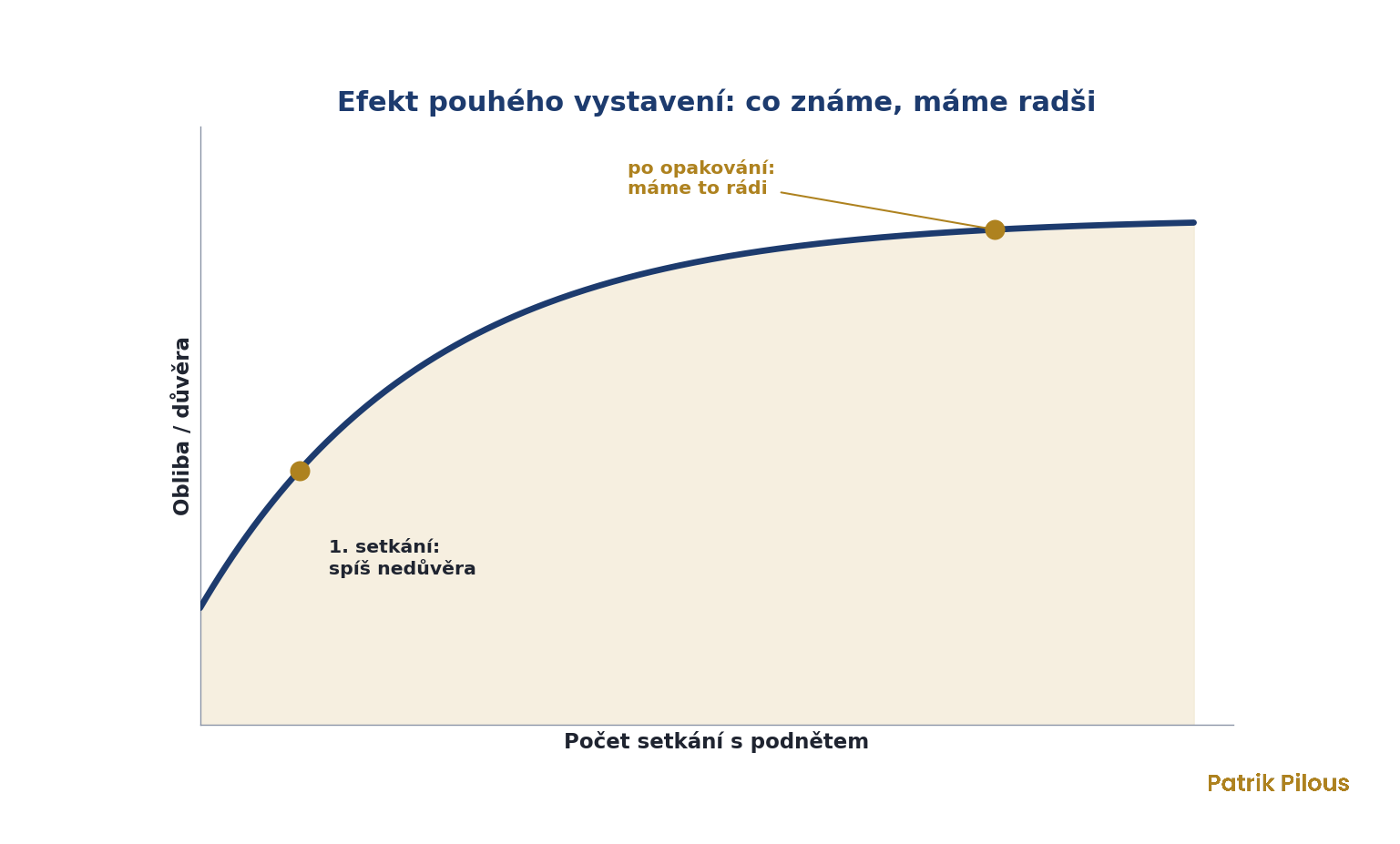
The mere exposure effect is a cognitive bias that makes us like something simply because it is familiar. The more often we encounter a face, a brand or a melody, the more likeable and trustworthy it seems, without any additional information. Repeated exposure alone is enough for it to grow on us. How strongly this bias works also depends a great deal on the individual. Many people are completely at its mercy.
Classifying the cognitive bias
- Cause (Cognitive Bias Codex): Too much information
- Mental domain: Perception and memory
- Marketing function: Memory and perception
- Buyer journey: Attention
- Cialdini’s principles: not applicable
- System 1 / System 2: System 1 (fast, automatic)
In a nutshell
- What it is: we prefer what we know, even without any other reason.
- Where you encounter it: repeated advertising, colleagues, retargeting, jingles, a consistent logo and colours.
- How to use it: build your brand through repetition and consistency over time, not in a single burst.
A real-life story
The best historical example is in Paris. When the Eiffel Tower was being built in 1889, the artistic and intellectual elite hated it. A group of famous writers and artists drew up a petition calling it a monstrous iron chimney that disfigured the city. Today the tower is a symbol of Paris, of romance and of France as a whole. The tower did not change. What changed was how often people saw it. They got used to it and fell in love with it. That is the mere exposure effect straight out of a textbook.
You know it from the radio too. A new song gets on your nerves the first time you hear it. After the fifth play you tolerate it. After the tenth you catch yourself humming it in the shower. Repetition alone turned someone else’s song into yours.
The psychologist Robert Zajonc proved it scientifically back in 1968. He showed people unfamiliar Chinese characters, made-up words and photos of strangers’ faces. A simple rule applied: the more times a person had seen a given stimulus, the more positively they rated it afterwards. No additional information, just repetition.
Fun fact: the same effect explains why we sometimes dislike photos of ourselves. In the mirror we see ourselves reversed, and that is the version of our face we are used to. In a photo we appear “the right way round”, yet it looks strange to us. Our friends, who know us in real life, find it easier to like us in photos than we do.
How the mere exposure effect works
The effect rests on simple evolutionary logic. What is familiar has so far been safe, otherwise we would no longer be here. The unfamiliar is a potential risk. So the brain reads a repeated encounter without a bad experience as a signal that “this is fine” and increases liking. In technical terms, this is helped by so-called processing fluency. We process a familiar stimulus more easily and mistake this pleasant feeling of ease for liking. Closely related are priming and the halo effect.
Use in marketing
- Frequency and retargeting. Repeated ad impressions build awareness and trust. One view is forgotten, but by the tenth the brand has settled into people’s minds.
- Consistent visual identity. The same colours, logo and style everywhere speed up recognition. Inconsistency wipes out the effect, because you start from scratch every time. That is exactly why consistency is the foundation of good branding.
- Top of mind. Regular content, a newsletter and a presence on social media keep the brand “in sight”, so at the moment of purchase the customer thinks of you.
- Jingles and slogans. A repeated melody or line settles in and comes to mind on its own. I write about how to create them in my article on advertising slogans.
- Product placement. Subtle, repeated exposure of a brand in films and through influencers works precisely through familiarity, not through a direct appeal.
- Patience. A brand is built through repetition over time. Anyone expecting a miracle from a single campaign usually ends up disappointed.
How to guard against the mere exposure effect
- Separate familiarity from quality. Seeing a brand often does not mean it is the best. Ask about facts, not feelings.
- Take care with important decisions. When it comes to money and health, do not rely on “but I know this brand”. Familiarity is not proof.
- Give the unfamiliar a chance too. The most visible option is not necessarily the best one, just the most heavily promoted.
The mere exposure effect is the reason why, in marketing, patience and consistency are often more valuable than a single clever outburst. Brands are not built in one burst but through repetition that people come to believe over time.
Frequently asked questions
What is the mere exposure effect?
A cognitive bias that makes us like something simply because it is familiar. Repeated encounters with a stimulus increase how much we like it, even without additional information.
Who described the mere exposure effect?
The psychologist Robert Zajonc in 1968, using experiments with unfamiliar characters, words and faces, among others.
How can you use the mere exposure effect in marketing?
Through ad frequency, retargeting, a consistent visual identity and a regular presence, so that the brand earns trust through repetition.

