
The Dunning-Kruger effect is a cognitive bias in which people with little knowledge of a subject overestimate their abilities. They lack the very knowledge they would need to recognise how little they know. Real experts are often the opposite: they underestimate themselves because they can see how much they still do not know.
Classification of the cognitive bias
- Cause (Cognitive Bias Codex): Need to act fast
- Mental area: Decision-making (self-assessment)
- Marketing function: Ego and beliefs
- Buyer journey: across the journey (content segmentation)
- Cialdini’s principles: not applicable
- System 1 / System 2: System 1 (automatic overestimation)
In a nutshell
- What it is: the less we know about something, the more confident we tend to be in our judgement.
- Where you’ll see it: “anyone can do marketing”, self-proclaimed experts, the client who knows better about everything after a weekend on YouTube.
- How to use it: create separate content for confident beginners and for humble experts. Each group needs a different language.
A real-life story
In 1995, a man named McArthur Wheeler robbed two banks in Pittsburgh. No mask, in broad daylight, calmly looking into the cameras. Thanks to the footage, the police caught him within a few hours. When they showed him the recordings, he was genuinely horrified. “But I wore the juice,” he protested.
Wheeler was convinced that if he rubbed lemon juice on his face, the cameras would not capture him, because lemon juice is used as invisible ink. He had tested it at home with a selfie, and he really could not see himself in the photo (he probably pointed the camera the wrong way). His knowledge of chemistry was so limited that it did not allow him to see how absurd the plan was.
It was this very case that inspired psychologists David Dunning and Justin Kruger to carry out their research. Their conclusion can be summed up in one sentence: to recognise that you are bad at something, you need roughly the same knowledge as you need to be good at it. And if you lack it, you lack both.
How the Dunning-Kruger effect works
In 1999, at Cornell University, Dunning and Kruger tested students on logic, grammar and sense of humour. They then asked them how they thought they had done. The worst performers systematically ranked themselves well above average. They lacked metacognition, the ability to assess their own performance.
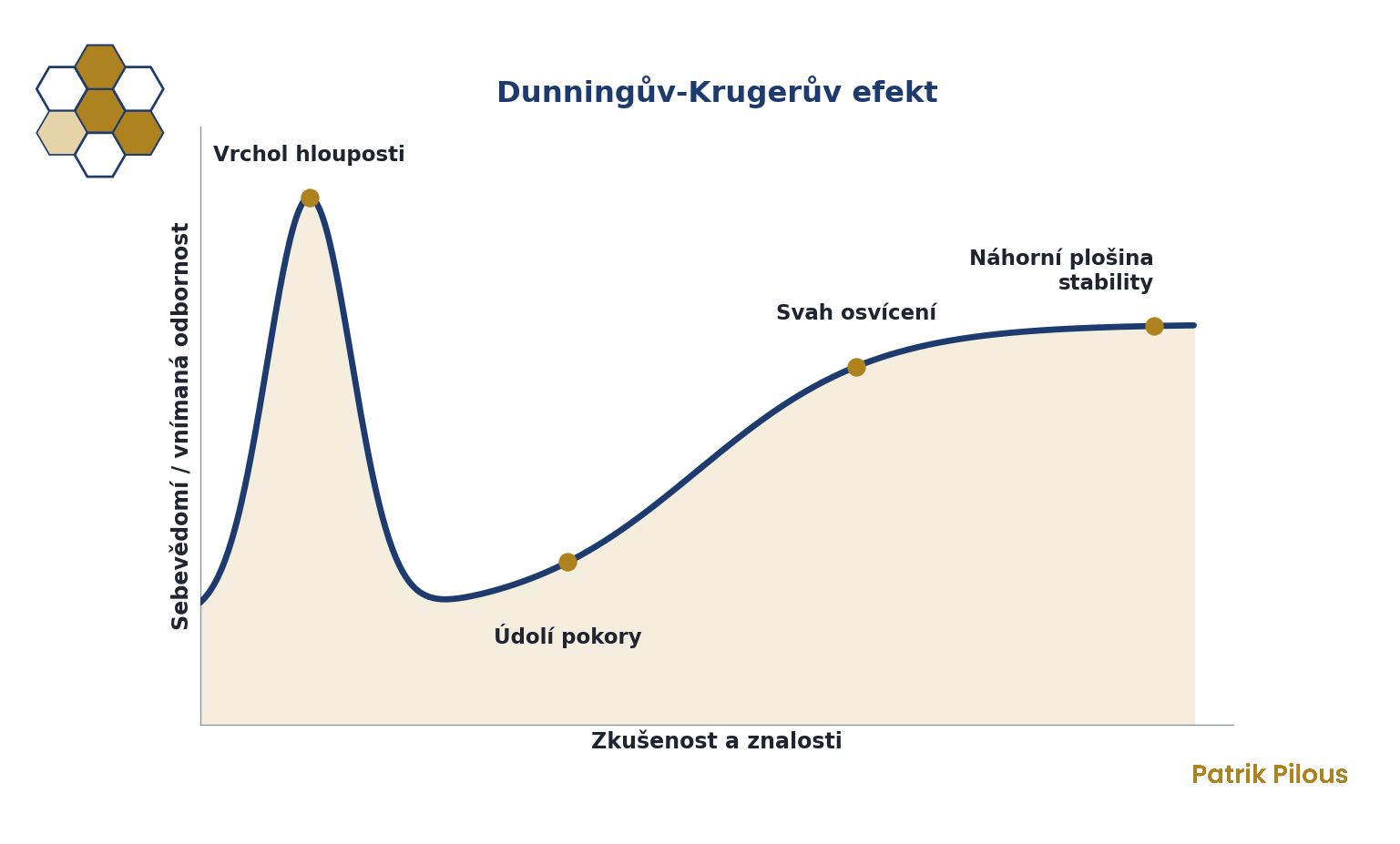
The curve of the effect has a typical shape. At the start of learning comes a rapid peak of confidence, nicknamed “Mount Stupid”. We know little, but we feel like experts because we cannot yet see everything we do not know. Then comes the fall into the “valley of humility”, where the more we learn, the more clearly we see the extent of our own ignorance. Only with real competence does confidence slowly return, but this time it is well founded.
It is important not to link this effect with intelligence. It does not mean that stupid people are confident. It means that in any area where we are newcomers, we cannot gauge our own ignorance. It applies to absolutely everyone, just in different subjects.
Use in marketing
- Segment your content by level. A beginner on Mount Stupid looks for simple, confident solutions. An expert in the valley of humility looks for nuance and data. If you write for both groups in the same way, you will miss both.
- Courses and info products for beginners. Promises like “master it in a weekend” work precisely because newcomers have no idea how much they do not know. What is being sold to them is certainty, not content.
- Onboarding that holds their hand. New users overestimate what they can manage on their own. Offer guidance so they do not hit a wall and leave frustrated right at the start.
- Reviews tailored to the level. A beginner is convinced by “it was easy”. An expert is convinced by “finally, a tool that handles the edge cases too”. Put both on your website.
- Working with a client who knows better. Do not argue with a client who is explaining your own field to you. Show them one specific example from the data where their intuition fails. This gently moves them into the valley of humility and they start listening.
How to guard against the effect
- Assume you are a newcomer. In a new area, automatically assume you are standing on Mount Stupid, not that you are the exception.
- Ask what you still do not know. The question “what is it that I don’t even know I don’t know?” is uncomfortable, but it will take you further than confidence.
- Recognise a true expert by their doubts. A real expert will give you plenty of “it depends on the context” and caveats. Anyone promising you simple certainty may well be standing on Mount Stupid themselves.
Frequently asked questions
What is the Dunning-Kruger effect?
A cognitive bias in which people with a low level of knowledge overestimate their abilities because they lack the knowledge needed to recognise their own incompetence.
Who discovered the Dunning-Kruger effect?
Psychologists David Dunning and Justin Kruger, who described it in a 1999 study from Cornell University.
Does the Dunning-Kruger effect mean that someone is stupid?
No. It affects everyone in an area where they are a newcomer. It is not about intelligence, but about the inability to gauge one’s own ignorance in a specific subject.
How can the Dunning-Kruger effect be used in marketing?
By segmenting content according to the audience’s level: simple solutions and certainty for confident beginners, and nuance, data and solutions for edge cases for experienced users.

