
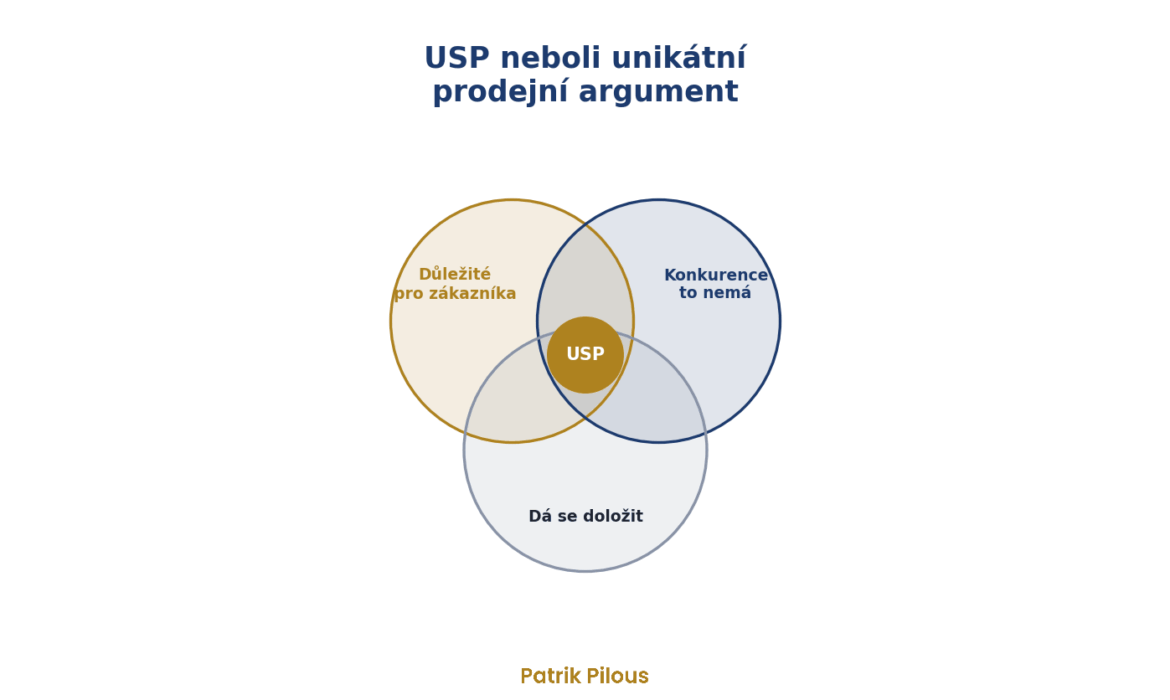
A USP (Unique Selling Proposition) is a single, specific reason to buy. It is something only you offer, or something only you can state clearly and prove, and it makes a customer choose you rather than a competitor. Both count as a USP, but the second one lasts for a shorter time. It fits into one sentence. A slogan is just a way of saying it, and a list of benefits usually dilutes it.
The term was popularised by the American advertising strategist Rosser Reeves of the Ted Bates agency. He used it in the agency’s campaigns, and in his 1961 book Reality in Advertising he summed it up in three rules. The advertisement must promise the customer a specific benefit, competitors must not offer it, and the promise must be strong enough to attract new customers to the product.
“The proposition must be one that the competition either cannot, or does not, offer.”
Rosser Reeves, Reality in Advertising, 1961, according to Robert W. Bly
Reeves was also behind the famous 1954 line “M&M’s melt in your mouth, not in your hand”. M&M’s sweets had withstood heat since 1941. But only this sentence turned that property into a reason to buy.
Why “quality and a professional approach” is not a USP
When I ask companies how they differ from their competitors, I most often hear quality, fair prices and a professional approach. But competitors say exactly the same about themselves. An argument anyone can use does not help a customer decide.
So why do companies still write it? I have two hypotheses. A) It is true, so it feels like an argument. B) Nobody in the meeting wants to say out loud that the company is not very different from its competitors. Usually both apply (with honourable exceptions).
Customers see it in a similar way. In 2013, CEB and Google asked 3,000 business customers of 36 brands whether they saw a real difference between suppliers that they would pay extra for. Only around 14% said yes. According to the authors, customers take business benefits for granted as something every supplier must deliver. The figure will be different for consumers, but the principle is the same.
Youngme Moon of Harvard Business School explains why in an interview about her book Different. In her view, competitive pressure breeds sameness, and as more products enter a category, the differences between them become less and less meaningful.
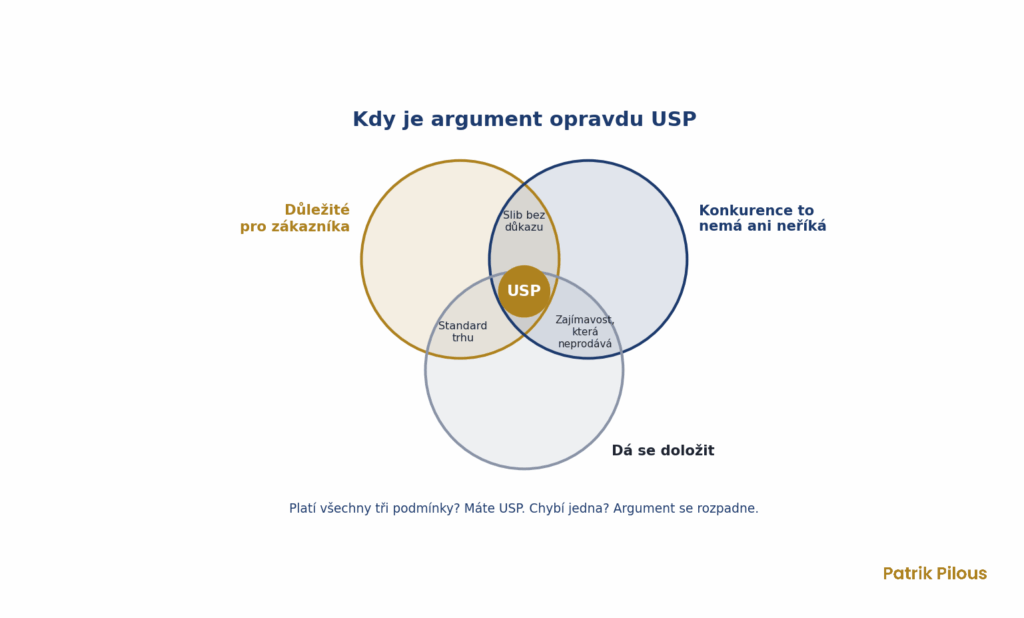
A good USP meets three conditions. It matters to the customer, competitors do not have it or do not talk about it, and it can be proved. If just one of them fails, the argument falls apart.
The covered logo test helps. Read the main message on your website without the company name. Could the same sentence appear on the websites of three other companies in your industry? Then you do not have a USP yet.
Be careful with the second condition. An argument your competitors simply have not talked about yet will only last until they copy it. A strong USP rests on something hard to copy, such as your own production or data that only your company has.
USP, positioning and slogan are not the same thing
These three terms are often confused. Brand positioning describes the place you want to occupy in the customer’s mind relative to competitors. The USP is the specific argument that defends that place. The slogan is the short, memorable phrase you use to communicate the argument.
| Positioning | USP | Slogan | |
|---|---|---|---|
| Question it answers | Where we want to sit in the customer’s mind | Why buy from us | How to remember it |
| Who it is for | The company and everyone who speaks for it | The customer when choosing | The customer in a campaign |
| How often it changes | Almost never | When the offer or the market changes | With every campaign, if you like |
| Example from pool chemicals | Pool water expert | Advice from a chemist who develops and makes the products himself | Chemicals from a chemist |
Why a chemist? Someone dealing with green water mainly needs certainty that they are dosing correctly. An online shop that only resells chemicals cannot offer advice with the same certainty as the people who make the product. If you want inspiration for the last column, I have picked the best advertising slogans.
The value proposition is often added to the mix. It describes everything the customer gets from you, meaning the product, service, price and peace of mind. The USP is only the part of it that nobody else has. Your value proposition can be similar to your competitors’, but your USP cannot.
How to find your USP from data, not from a management meeting
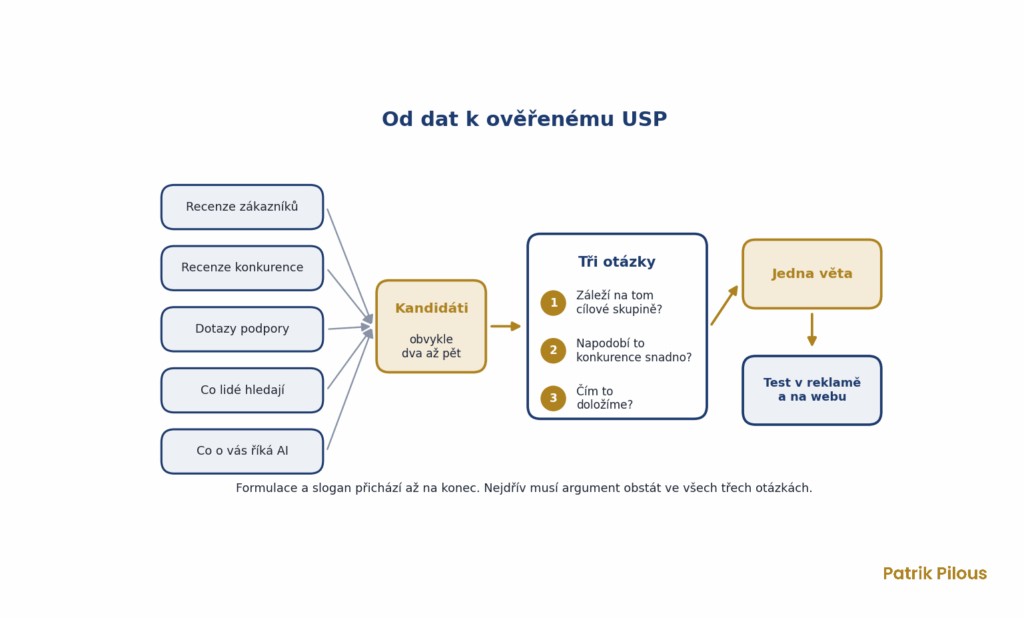
Most USPs are born in a meeting where management chooses how it would like to stand out. It is more reliable to start with customers and with what they actually search for and deal with. I use five sources, and each one reveals something different.
1. Your customers’ reviews. Do not read the stars, read the words. If reviews keep mentioning that someone who understands the product gave advice, you have a stronger candidate than “quality goods”.
2. Competitors’ reviews. The negative ones are really valuable. Whatever customers complain about with your competitors is where you can stand out. Long delivery times, instructions nobody understands, support that does not answer the phone.
3. Customer support questions. Emails and phone calls show what worries people before they buy. A recurring question is often an unspoken objection, and a USP that answers it in advance spares the customer the hesitation.
4. What people search for. Search data reveals the words customers use to describe their problem. Do people search for the product “without chlorine” or “made in the Czech Republic”? You have a lead. But searching alone does not prove that people buy because of it. Only a test will confirm that.
5. What AI says about you. Ask ChatGPT or Perplexity, using several different phrasings, what they recommend in your industry and why. If they repeatedly fail to mention you, or describe you differently from how you want, it is a sign that your difference is not coming through clearly enough on your website and in the media.
How to pull candidates out of reviews
Do not read reviews one by one, read them by theme. Take the last 100 to 200 reviews of your own and of your competitors, note one or two themes each review mentions, and count how often each theme recurs. By hand this takes an afternoon, with AI sorting the reviews by theme it takes about an hour (but spot-check the result).
| Theme in reviews | Your reviews (out of 150) | Competitors’ reviews (out of 150) | What it means |
|---|---|---|---|
| They helped me with dosing | 31 (21 %) | 4 (3 %) | strong candidate, sets you apart |
| Fast delivery | 40 (27 %) | 38 (25 %) | important, but does not differentiate |
| Low price | 9 (6 %) | 22 (15 %) | competitors are stronger here |
| Confusing instructions | 2 (1 %) | 17 (11 %) | competitors’ complaint, an opening for you |
The numbers in the table are a made-up example, but I often see a similar pattern in practice. As a working rule, I treat a theme as a candidate if at least a tenth of your reviews mention it and no more than a few percent of your competitors’ reviews do. A theme that is equally common for everyone is a basic requirement. You cannot sell without it, but nobody will choose you because of it.
Customers trust reviews, which is why they also work as proof for the third condition. According to the Spiegel Research Center at Northwestern University in 2017, a product with five reviews was 270% more likely to be purchased than a product with no reviews. The data came from a company that sells review software, so take it with a pinch of salt.
How to pick the strongest candidate
The five sources usually produce two to five candidates. Apply the three conditions of a good USP to each one as three questions. Does it matter to the customer? Do competitors lack it, and is it hard to copy? Can it be proved? Give each 0 to 3 points and multiply the points, do not add them up. That way, a candidate the customer does not care about, or that everyone has, gets zero overall, even if it excels in the other two.
| Candidate | Importance to the customer | Competitors lack it and will struggle to copy it | Can be proved | Total |
|---|---|---|---|---|
| Advice from a chemist who makes the products | 3 | 3 | 3 | 27 |
| Made in the Czech Republic | 2 | 2 | 3 | 12 |
| Instructions anyone can understand | 2 | 2 | 2 | 8 |
| Next-day delivery | 3 | 0 | 3 | 0 |
Do not award points from behind your desk. Take importance from reviews and support questions, difference from reviews and competitors’ websites, and provability from whether you have a number, a certificate, a name or a process the customer can verify. In the example, Made in the Czech Republic came from search data, the other candidates from reviews. The thresholds are my working rule, not science. A product of 18 or more, meaning at least two threes and a two, is a clear winner. A candidate with 8 to 12 points needs strengthening in the condition where it scores lowest.
What if no candidate reaches even 8? Then you have nothing to communicate yet, and better wording will not fix that. The USP has to be built into your offer, for example through a service, a guarantee or advice your competitors do not provide. Only then does it make sense to work out how to write it.
One sentence your USP has to fit into
If you cannot state your USP in one sentence, it is not finished. I use a template that my client and I fill in before anyone starts on design or a slogan.
For [whom] we are [what we offer], because [how we prove it], unlike [the competitor or other solution the customer is considering].
For pool chemicals, it could sound like this. For pool owners who do not want to experiment with dosing, we are an online shop where a chemist gives advice, because we develop and make the products ourselves, unlike general online shops with thousands of items from other categories.
The sentence does not belong on your website in this form. It is the brief for everything else, from the website header to what customer support says on the phone. And if your company cannot agree on it? Then you have just found out why your communication sounds slightly different every time.
Unique selling proposition examples from well-known brands
Classic examples show the three conditions at work. None of them is a list of benefits. Each one is a single promise that a customer can check.
- FedEx. “When it absolutely, positively has to be there overnight.” The promise mattered to anyone sending urgent documents, and it was easy to verify. The customer knew the next morning whether it had been kept.
- Domino’s. Pizza delivered within 30 minutes, or it is free. It said nothing about taste. It promised speed and added a guarantee, which made the claim provable. The guarantee was later dropped, a reminder that a USP only lasts as long as you can keep it.
- Avis. “We try harder.” Avis turned its position as number two in car rental into a reason to choose it. A company that cannot take customers for granted has to put in more effort for each one.
What these have in common is that each one answers a worry the customer already has. Will it arrive in time? Will I wait too long? Will anyone care about me?
The same works for small companies. An accounting firm offering “comprehensive accounting services” sounds like every other firm. “You always deal with the same accountant, and you get an answer within one working day” is specific, matters to a busy owner and can be checked from the first email you send.
How to tell whether your USP works
A USP is not validated by management liking it. The quickest way is an advertising test. Run two versions of the message against each other in a performance campaign with the same audience, budget and offer, where only the argument differs. Track both the click-through rate and the conversion rate.
In Google Ads, experiments do this job. They split a campaign’s traffic and budget between the original and the modified version, ideally half and half. People are assigned to the versions at random and both run on the same days, so the difference is not distorted by the season or the day of the week.
To estimate how much data a test needs, use the rule of thumb that the American statistician Evan Miller gives in his guide to A/B testing.
n ≈ 16 × p × (1 − p) / d²
n is the number of impressions or visits per variant, p is the baseline click-through or conversion rate and d is the difference you want to detect. An improvement from 3% to 3.6% is a fifth in relative terms, but the formula needs the absolute difference, which is 0.006.
| What you are testing | Baseline | You want to detect a one-fifth improvement | You need per variant |
|---|---|---|---|
| Ad click-through rate | 3 % | to 3.6% | roughly 13,000 impressions |
| Landing page conversion | 2 % | to 2.4% | roughly 19,600 visits, or about 400 orders |
Ad impressions are cheap, so test your arguments on click-through rate first. With a campaign that gets thousands of impressions a day, you will have a result within a few days to a few weeks. A higher click-through rate does not automatically mean more purchases, though, so check the winner’s conversion rate as well.
If the tested page got 500 visits a day, a clean conversion test with two variants would take almost 80 days. For seasonal products, that is the whole season.
And do not make decisions along the way. If you look at the results every day and stop the test the moment your favourite version is ahead, you will declare a winner more often than you should. In the same text, Miller warns that repeated significance testing always increases the rate of false positives. So calculate the sample size in advance and run the test until you reach it.
The second test happens on your website. Place the USP in the main part of the landing page and run an A/B test. For an online shop, also watch whether support enquiries go down. A good USP answers questions before the customer asks them.
A simple before-and-after comparison does not work for seasonal products, because spring always beats winter. A comparison with the same period last year accounts for the season, but not for other changes between the years, so it is only a fallback.
In the long run, the USP shows in how people remember you. When customers start mentioning in their reviews the same argument you communicate, the brand has created the association in their minds that you were aiming for.
USP for an online shop and for a B2B company
In an online shop, the USP has to be visible within a few seconds. According to a 2011 analysis by Nielsen Norman Group, people often leave a page within 10 to 20 seconds, and whether they stay is decided mainly in the first ten.
On top of that, the customer has other shops open in other tabs and is comparing, so the argument belongs everywhere a decision is made. What often wins is whatever saves them hassle. Advice, fast delivery, easy returns.
| Place in the online shop | What the USP should do there | What to track |
|---|---|---|
| Header and homepage | say why to buy here | test with the logo covered |
| Product page | repeat the argument for the specific product | visible on mobile without scrolling |
| Basket and checkout | remove the last doubt | basket abandonment rate |
| Post-order email | confirm the choice was right | support enquiries after purchase |
| Advertising | bring in people for whom the argument makes sense | click-through rate by message version |
B2B is different. Buying usually takes longer and more people are involved in the decision, so the USP has to work differently for a director than for an engineer or a buyer. One sentence for all three is almost never enough.
| Who decides | What they want to hear | How to prove it |
|---|---|---|
| Director or owner | savings, growth, reliable supply | return on investment calculation, industry references |
| Engineer | specifications, compatibility, service | technical data sheet, test, certification |
| Buyer | total cost over the product’s lifetime, terms | total cost comparison, contractual guarantees |
In Harvard Business Review, James Anderson, James Narus and Wouter van Rossum distinguish three types of value proposition. All benefits, points of difference from competitors, and a focus on the few things that matter most to the target customer.
They recommend the third, because with a list of all benefits, companies easily praise features the customer does not care about at all. Focusing on a few things the customer really cares about is exactly what makes a good USP.
Business customers also do not particularly want to talk to a salesperson. According to a 2025 Gartner survey of 632 people who make purchasing decisions in companies, 61% would prefer to go through the entire purchase without a sales representative. So the USP has to be clear from the website, not only in a meeting.
This is the work I deal with most often as an outsourced CMO. Aligning what a company claims about itself in its advertising, emails, packaging and in what its salespeople say.
Why the USP matters in AI answers too
Language models build their recommendations largely from what the internet repeatedly says about brands. Ahrefs showed on 75,000 brands that brand mentions on the web correlate more strongly with visibility in Google’s AI Mode than the strength of the backlink profile does. It is a correlation and Ahrefs sells measurement, so take it with a pinch of salt.
A company that writes “quality and a professional approach” about itself everywhere blends in with the rest there too. In my view, a company with a clear, evidenced argument has a better chance that AI will repeat it when someone asks where to buy. So the USP has to come across the same way on your website, in articles about you and in catalogues. I explain how AI builds a picture of a brand from these sources in the article why SEO and AI visibility rest on associations and entities.
Advantages and limits of a USP in marketing
Thinking in terms of a unique selling proposition brings clear benefits, but it is not the answer to every marketing problem.
What it gives you
- Focus. Every advert, page and email has one main job, so it is easier to decide what to leave out.
- Consistency. Sales, support and marketing repeat the same argument, which helps people remember it.
- Easier comparison for the customer. When someone has several suppliers open side by side, one clear reason is easier to weigh than ten vague ones.
- Better product decisions. Once you know what sets you apart, you know where to invest so the difference stays real.
Where it reaches its limits
- Near-identical categories. With products such as petrol or bottled water, a hard functional difference may not exist. Familiarity, availability and a recognisable brand often do more of the work there.
- Emotional purchases. For fashion or gifts, people rarely buy for one rational reason, so a single argument carries less weight.
- A narrower audience. A sharp promise attracts some people and leaves others cold. That is intended, but it can feel uncomfortable if you are used to speaking to everyone.
When a USP does not work
Most often when it is actually a product feature. “We have 500 products” is a fact, not a reason to buy. The reason is what the customer gets out of it, for example that they can buy everything for their pool in one place instead of ordering from three online shops. Theodore Levitt of Harvard Business School explained this difference to his students using a drill.
“People don’t want a quarter-inch drill. They want a quarter-inch hole.”
Theodore Levitt, according to the abstract of the article Marketing Malpractice by Clayton M. Christensen, Scott Cook and Taddy Hall, Harvard Business Review, 2005
Christensen and his colleagues built on the same idea a theory that we hire a product to do a job for us (HBR, 2016). A good USP therefore describes what job you do for the customer better than others, not what the product is equipped with.
Another trap is an argument you cannot prove. A customer can check “the best prices on the market” on a price comparison site in a minute, and if it is not true, you lose their trust before you manage to sell anything.
And then there is impatience. An argument needs time for people to link it with the brand, so changing your USP with every campaign is a sure way to make sure nobody remembers it. As long as it holds and works, change the wording rather than the substance. Review it again when your offer or your competitors change.
If you are not sure what really sets your company apart, start with a marketing strategy. The USP is one of the first things my clients and I look for in it. And if you would like me to look at your argument from the outside, get in touch.
Frequently asked questions about the unique selling proposition
What is a unique selling proposition?
A unique selling proposition is one specific reason to buy from you rather than from a competitor. It has to matter to the customer, competitors must not offer it or talk about it, and you must be able to prove it. It should fit into a single sentence.
What does USP mean in marketing?
In marketing, USP stands for unique selling proposition. It is the central argument that your adverts, website, packaging and sales conversations all repeat. It differs from a slogan, which is only one way of putting the argument into words.
What are some unique selling proposition examples?
Well-known examples include FedEx’s promise of overnight delivery, Domino’s pizza delivered within 30 minutes or free, and Avis with “We try harder”. Each one makes a single, specific promise that customers can check for themselves.
Can a company have more than one USP?
A company can have several strengths, but it should lead with one main USP. Several equally weighted arguments dilute each other and are harder to remember. In B2B, you can stress different proof for different decision makers while keeping the same core argument.

