

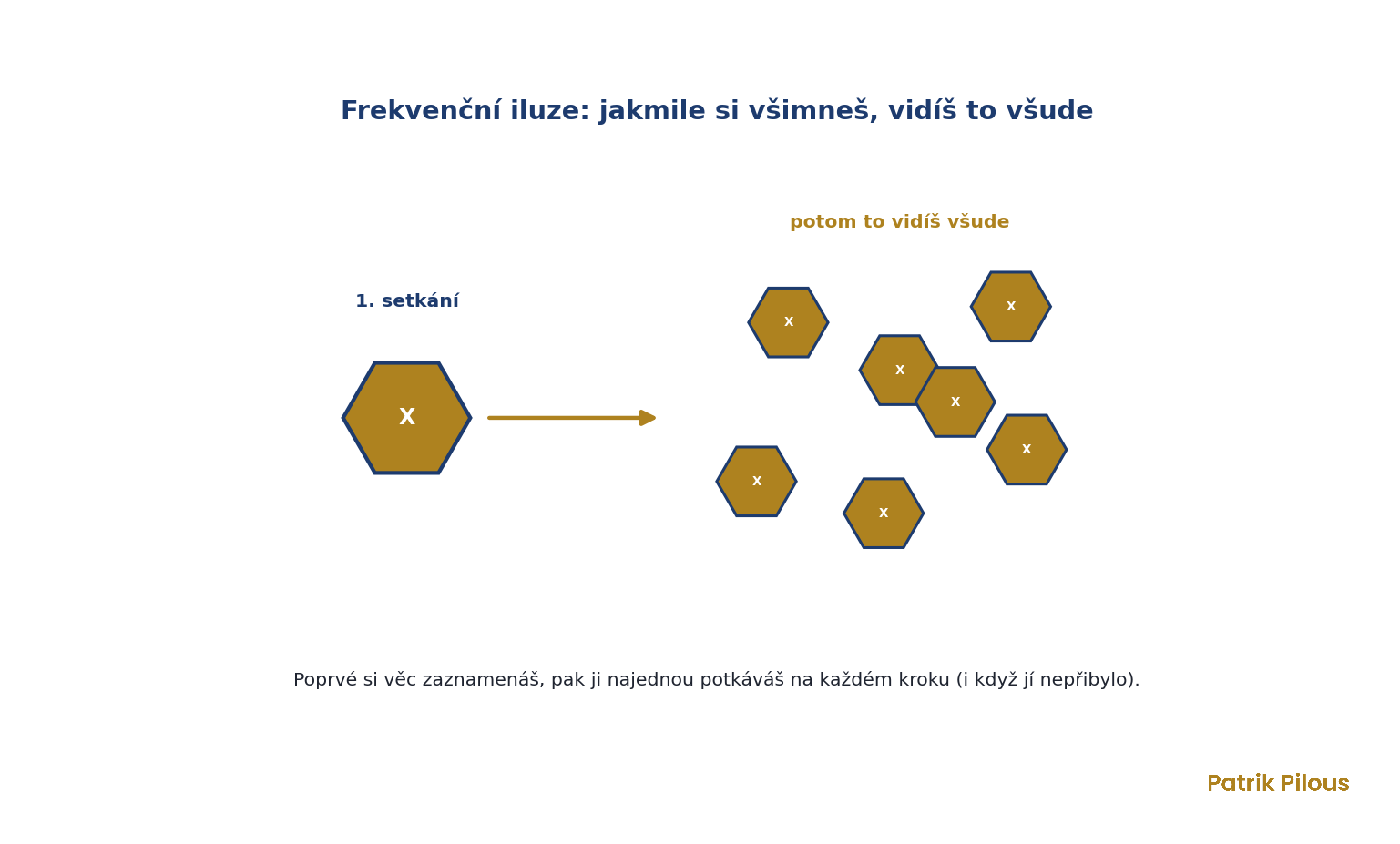
The frequency illusion, also known as the Baader-Meinhof phenomenon, is a cognitive bias that makes us feel that something we noticed for the first time recently is suddenly all around us. You buy a car of a certain brand and suddenly you see them at every junction. You learn a new word and hear it three times in a week. Yet nothing has changed, and there are no more cars or words than before. The only thing that has changed is your brain, which has started to notice and register that thing. For marketing, this is a crucial phenomenon, because it explains exactly why repeated advertising, retargeting and brand awareness building work.
Classification
- Cause (Cognitive Bias Codex): Too much information
- Mental area: Attention and perception
- Marketing function: Brand awareness
- Customer journey: Attention and consideration
- Cialdini’s principles: not applicable
- System 1 / System 2: System 1 (fast, automatic)
In a nutshell
- What it is: once you notice something, you start seeing it everywhere.
- Why we do it: the brain starts actively looking for the newly registered thing.
- Where you will encounter it: retargeting, remarketing, repeated advertising, brand building.
- How to use it: repeat your brand’s presence to create the feeling that it is everywhere.
A real-life story
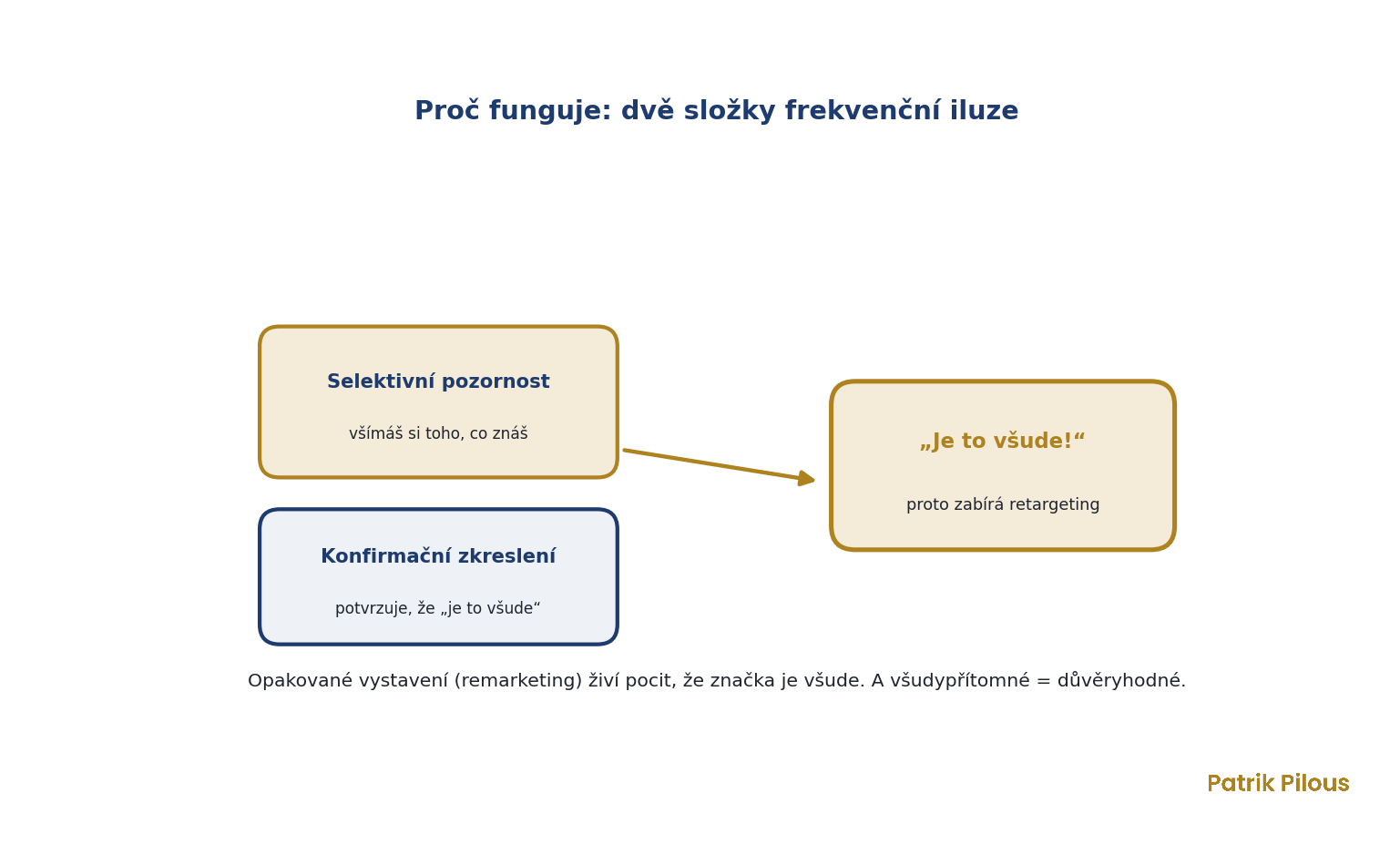
This phenomenon got its unusual name by chance. In 1994, a reader wrote to the American newspaper St. Paul Pioneer Press that after hearing about the German terrorist group Baader-Meinhof for the first time, he came across it again within a single day. The name stuck. The more technical term, frequency illusion, was only introduced in 2005 by the Stanford linguist Arnold Zwicky, who described the phenomenon as resting on two components: selective attention and what is known as confirmation bias.
You will certainly know this yourself. You decide on a particular model of pushchair or shoes and suddenly you see them on every corner, as if everyone had them. Objectively, there are no more of them than before, you just did not notice them previously. After the first encounter, your brain created a filter that reacts to that thing and loudly announces every further occurrence. And because there seem to be so many of them, the thing starts to feel important and widespread to you.
How the frequency illusion works
It rests on two mechanisms that combine. The first is selective attention. As soon as something catches our attention, the brain starts registering it as a priority, even if we are not aware of it. The second is confirmation bias. We take every further occurrence as proof that “it is suddenly everywhere” and ignore the fact that it was like this all along. The phenomenon is closely related to the mere exposure effect and priming, because they all rest on how previous contact with a stimulus influences us.
Use in marketing
- Retargeting and remarketing. Ads that follow you across websites are built precisely on the frequency illusion. After the first contact, you start seeing the brand everywhere and it seems bigger and more trustworthy to you.
- Repeated advertising. A single view gets lost, while repeated exposure creates a sense of ubiquity. This is related to the mere exposure effect.
- Consistent branding. When a brand uses the same colours and visuals everywhere, the brain recognises it more easily and registers it at every further encounter.
- Launching something new. Before a product launch, create the first contact (a teaser). After that, people start noticing everything connected with the new product.
- Presence across multiple channels. When a customer comes across you on your website, on social media and in your newsletter, the impression that you are “everywhere” grows stronger, even with a small budget spread out cleverly.
- Top of mind. A brand that people see repeatedly comes to mind more easily at the moment of purchase. The availability heuristic also helps here.
Why retargeting works, the two components of the illusion
Once you understand what the frequency illusion is made of, you will also understand why retargeting is so effective and, at the same time, sometimes annoying. All it takes is for a customer to notice you once, and their selective attention tunes in to your brand. Confirmation bias then interprets every further impression as proof that you are “simply everywhere”. And because we subconsciously associate ubiquity with size and success, trust grows too. The key is not to overdo the frequency, so that pleasant ubiquity does not turn into harassment.
How to protect yourself from the frequency illusion
- Ask whether there really is more of it. The feeling that “it is suddenly everywhere” usually means you have started noticing it, not that there is more of it.
- Be careful when making decisions. Seeing a brand everywhere does not mean it is the best, only that its advertising has reached you effectively.
- Do not confuse visibility with prevalence. Ubiquity within your bubble is not the same as reality.
How it connects with other biases
The frequency illusion actually links several biases together. It rests on confirmation bias and is closely related to the mere exposure effect and the illusory truth effect. When a brand reaches you repeatedly, you start seeing it everywhere (frequency illusion), you grow fond of it (mere exposure) and its message starts to sound more true to you (illusory truth). Together, this is why brands are built through patient repetition. You can find the full overview in the encyclopaedia of cognitive biases.
Frequently asked questions
What is the frequency illusion?
A cognitive bias that makes us feel that something we noticed recently is suddenly everywhere, even though there is actually no more of it.
Why is it called the Baader-Meinhof phenomenon?
It is named after a chance letter from a reader of an American newspaper in 1994, who heard the name of the terrorist group Baader-Meinhof twice in quick succession. The technical term frequency illusion was introduced by the linguist Arnold Zwicky.
How can the frequency illusion be used in marketing?
Through retargeting, repeated advertising and a consistent presence across multiple channels, which after the first contact create the feeling that the brand is everywhere.

