

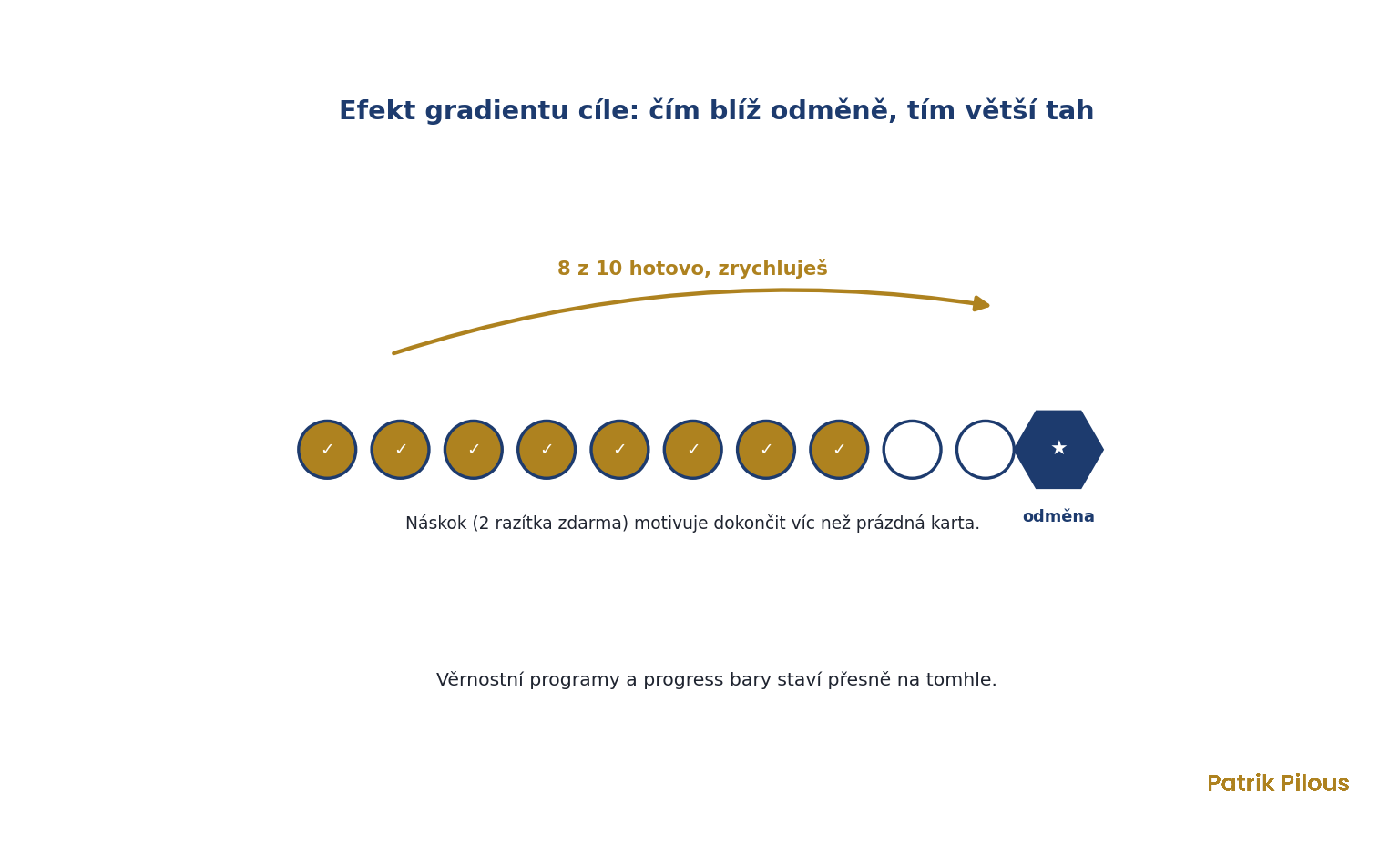
The goal-gradient effect is a cognitive bias in which our effort and motivation increase as we get closer to a goal. The less there is left before the reward, the harder we push to get it. That is why you speed up in the last metres of a race, finish your plate when only a few bites remain, and complete a loyalty card that is missing just one stamp. Being close to the goal pulls us forward. And, most valuable for marketing, that sense of closeness can be created artificially, for example by giving the customer a small head start. Loyalty programmes, gamification and well-designed progress bars are all built on this.
Classification
- Cause (Cognitive Bias Codex): Need to act fast
- Mental area: Motivational
- Marketing function: Retention and engagement
- Customer journey: Retention and repeat purchase
- Cialdini’s principles: not applicable
- System 1 / System 2: System 1 (fast, automatic)
In a nutshell
- What it is: the closer the goal, the greater the effort and motivation to complete it.
- Why we do it: being close to a reward strengthens the pull to get it.
- Where you will see it: loyalty programmes, progress bars, gamification, onboarding.
- How to use it: show progress and give people a small head start.
A real-life story
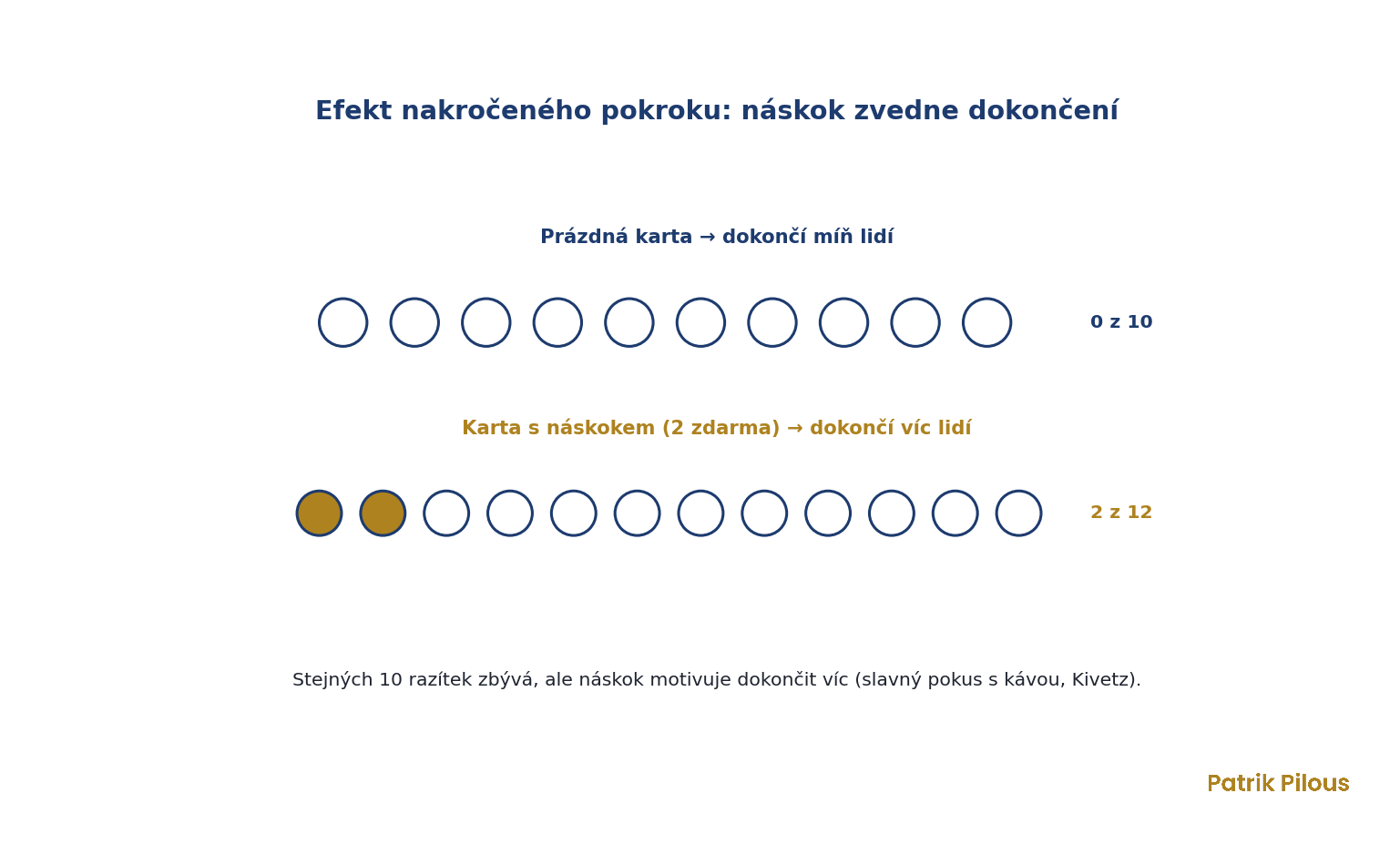
The effect was first described by psychologist Clark Hull back in 1932, when he observed that rats in a maze ran faster the closer they got to the reward. Many years later, researchers Ran Kivetz, Oleg Urminsky and Yuhuang Zheng confirmed it in people, and directly in marketing, in a 2006 study published in the Journal of Marketing Research. They handed out coffee shop loyalty cards to customers. One group received a blank card for ten coffees, the other a card for twelve coffees, but with two stamps already given in advance. Both groups actually had to buy the same ten coffees, yet the group with the head start collected stamps faster and more people completed the card. The mere feeling of something already under way spurred them on.
You know this from your own phone too. A message saying “your profile is 80% complete” makes you fill in the rest, even though you would not otherwise bother. Or a fitness app telling you that just one workout remains before you hit your weekly goal. That last bit suddenly becomes a reason to go.
How the goal-gradient effect works
Our brain reacts more strongly to a nearby reward than to a distant one. When we see that the goal is within reach, motivation rises sharply and we are willing to put in more effort than we would expect. What matters is how we perceive our progress, not how far we actually are. The effect is linked to the Zeigarnik effect, because an unfinished task gives us no peace, to the IKEA effect, because we are already putting effort into something in progress, and to the sunk cost fallacy, because we do not want the work we have put in to go to waste.
Use in marketing
- Loyalty programmes. Collecting stamps and points keeps customers with the brand. The closer they are to the reward, the more often they buy.
- Progress bars. A completion indicator for a profile, order or course pulls people towards finishing. It is worth checking in a UX audit too.
- Gamification. Levels, badges and milestones turn a dull task into a game with a clear goal that people enjoy working towards.
- Onboarding with a head start. If you show the first step of registration as already completed, the user is more likely to finish the whole process.
- A head-start beginning. A loyalty card with a few free stamps, or an account partly filled in for the customer, motivates more than an empty start.
- Visible closeness to the goal. “Just one more purchase to your reward” works better than an abstract “collect points”. This also belongs in a good retention marketing strategy.
A head start that boosts completion, the endowed progress effect
The head-start trick, known as the endowed progress effect, deserves special attention. It explains why a loyalty card with “two free stamps out of twelve” is more effective than a blank card for ten, even though the work is exactly the same. The head start changes perception. Starting from zero turns into something already under way that you are simply finishing. And we have a strong need to finish things we have started.
How to work with the goal-gradient effect
- Show progress. Let both the customer and you see how close to the goal you are. Invisible progress does not motivate.
- Give a reasonable head start. A small free start boosts completion more than an empty beginning.
- Watch yourself. Ask whether you are finishing something because it makes sense, or just because of the pull of a nearby goal.
How it combines with other biases
The goal-gradient effect and the Zeigarnik effect are a great pair for onboarding and loyalty. Zeigarnik says that an unfinished task gives us no peace; the goal gradient adds that the closer the end, the harder we push. Add the IKEA effect and the sunk cost fallacy, where we have already invested time in something and do not want it to go to waste, and you get a very strong motivation to complete a profile, a course or a set of stamps. That is why well-designed programmes are so habit-forming.
Frequently asked questions
What is the goal-gradient effect?
A cognitive bias in which our effort and motivation grow as we get closer to a goal. The less there is left before the reward, the harder we push.
What is the endowed progress effect?
A trick where you give the customer a small head start, for example two free stamps. Something already under way motivates completion more than an empty start.
How can the goal-gradient effect be used in marketing?
Through loyalty programmes, progress bars and gamification, which show progress and give people a sense of being close to the reward, as well as a small head start.

