
The Zeigarnik effect is a cognitive bias in which we remember unfinished or interrupted tasks better than completed ones, and they keep nagging at us until we finish them. Something left half-done creates a kind of tension in our minds that pushes us to see it through. Once we finish the task, the tension eases and we quickly forget about it. That is exactly why we feel such a persistent pull towards unfinished series, half-reached goals or a profile that is just a few per cent short of 100.
Classification of the cognitive bias
- Cause (Cognitive Bias Codex): What should we remember
- Mental area: Memory and motivation
- Marketing function: Memory and engagement
- Customer journey: Consideration and retention
- Cialdini’s principles: not applicable
- System 1 / System 2: System 1 (fast, automatic)
In a nutshell
- What it is: we remember unfinished tasks better and feel driven to complete them.
- Why we do it: something left half-done creates tension that wants to be released.
- Where you will see it: progress bars, “complete your profile”, cliffhangers, unfinished series.
- How to use it: show that something is in progress and that the finish is easy to reach.
A real-life story
The effect was described in the 1920s by the Lithuanian-Soviet psychologist Bluma Zeigarnik, after whom it is named. She was inspired by an ordinary scene in a café. She noticed that waiters remembered unpaid orders perfectly, but as soon as a guest paid and left, the order vanished from their minds within moments. The unfinished task stayed in memory, the finished one disappeared. She later confirmed her observation in the laboratory.
Imagine Pavel, who downloads an app and, while signing up, sees an indicator saying “your profile is 60% complete”. That unfinished bar will not leave him alone. He keeps coming back and filling in details just to reach 100, even though he would not otherwise bother. Series that cut an episode off at the most gripping moment work the same way. An unfinished story keeps us up at night and we click on the next episode.
How the Zeigarnik effect works
When we start a task, the brain opens an imaginary loop and keeps it active until we close it. This open loop uses up attention and keeps reminding us of itself, which we experience as an urge to finish the job. Finishing it closes the loop and the tension disappears. The effect is linked to the IKEA effect, because we have already put effort into the half-done thing, and to the sunk cost fallacy, where we do not want the work we have invested to go to waste.
Use in marketing
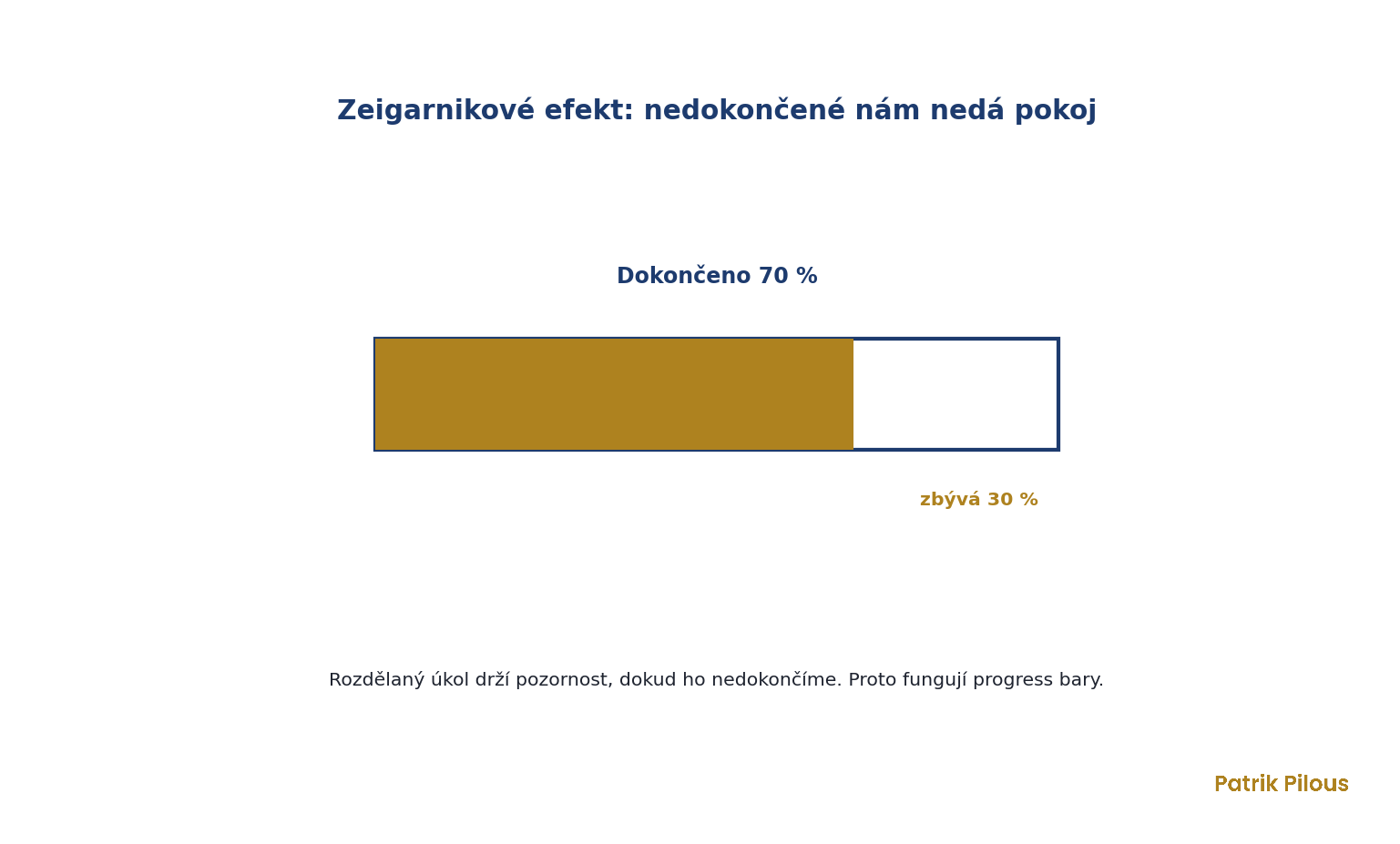
- Progress bars. An indicator saying “60% complete” on a profile or order pulls people towards finishing it.
- A head start. When onboarding begins with a few steps already completed, people are more likely to finish it.
- Cliffhangers in content. An unfinished story or “to be continued” keeps attention until the next instalment.
- Loyalty cards with a head start. A card that already has a few free stamps motivates people to complete it more than an empty one.
- Open loops in emails. Hint at a topic and promise the resolution in the next email, so the reader comes back.
How to protect yourself from the Zeigarnik effect
- Recognise the open loop. When you feel an urge to finish something, consider whether it is worth it or whether it is just the tension pushing you.
- Starting is not a commitment. Having started something does not oblige you to finish it at any cost.
- Watch out for habit loops. Series and games are built on this. Stopping consciously helps.
How it interacts with other biases
The Zeigarnik effect is the engine, but related biases give it its power. Take a progress bar saying “complete your profile, 80% done”. The unfinished bar creates tension, and that is the Zeigarnik effect. The time and details you have already put into the profile trigger the IKEA effect and the sunk cost fallacy, because you do not want them to go to waste. And once you have settled into the account, the endowment effect kicks in too. That is why well-designed onboarding is so effective.
Frequently asked questions
What is the Zeigarnik effect?
A cognitive bias in which we remember unfinished tasks better than completed ones and feel an urge to finish them, because they create tension in our minds.
How can the Zeigarnik effect be used in marketing?
Through progress bars, partly completed onboarding, loyalty cards with a head start and cliffhangers that push people to finish what they have started.

