
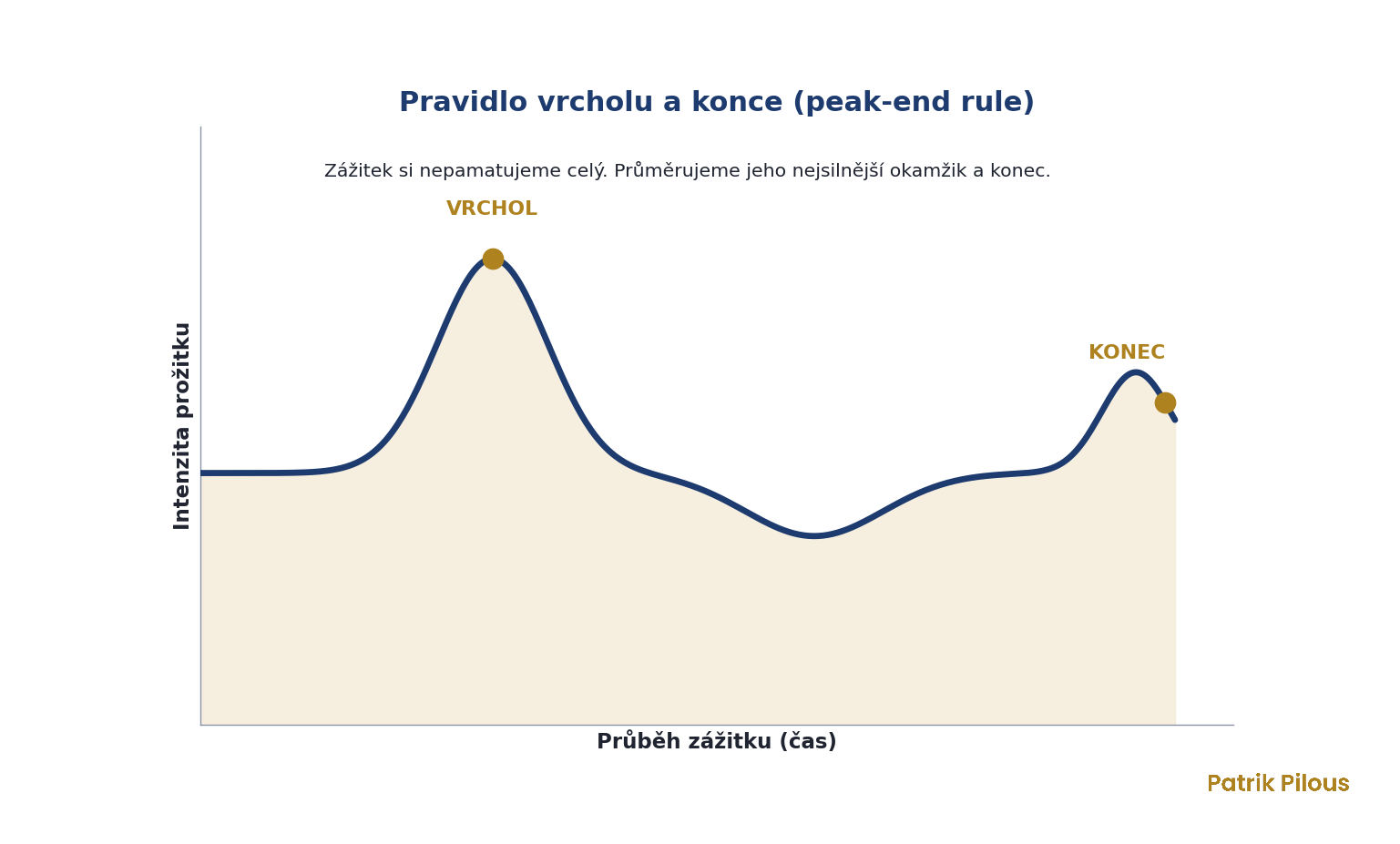
The peak-end rule is a cognitive bias in which we judge an entire experience mainly by two moments: its most intense point (the peak) and how it ended. How long it lasted or what it was like on average hardly matters. Our brain stores the peak and the end and then judges the whole experience by them. We can see this at the level of a single day as well as a month-long holiday. If a holiday was fairly good but had no notable positive peak, and we ran into some complications at the end, you may not rate it so highly with the passing of time.
Classification of the cognitive bias
- Cause (Cognitive Bias Codex): What to remember
- Mental domain: Memory
- Marketing function: Memory and customer experience
- Customer journey: Post-purchase and retention
- Cialdini’s principles: not applicable
- System 1 / System 2: System 1 (fast, automatic)
In brief
- What it is: we remember an experience by its peak and its end, not by the average or by how you felt for most of the time.
- Where you’ll come across it: checkout, unboxing a parcel, the end of a holiday, the last email, paying the bill in a restaurant.
- How to use it: create one strong moment and always finish on a positive note.
A real-life story
Imagine Tereza on holiday. The whole week was pleasant, nothing special. But on the second-to-last day she saw a breathtaking sunset that made her feel wonderful, and on the last evening the restaurant surprised her with a dessert on the house. When her friends later ask how it was, she says “wonderful”. Not because of the average of the seven days, but because of that one peak and the nice ending. If, on the other hand, the airport had lost her suitcase, the whole holiday would have turned sour in her memory, even if the rest had been great.
You know this from restaurants too. Great food, but an arrogant waiter who tosses the bill onto your table at the end can spoil the impression of the whole evening. And conversely, an ordinary lunch at the end of which they bring you a little something extra is one you’ll remember fondly.
Fun fact: At the end of your shopping trip, IKEA sells ice cream or a hot dog for a few crowns. It isn’t charity. A cheap treat at the very end of an often demanding visit full of hauling furniture creates a pleasant final impression that carries over to the whole experience of the store.
How the peak-end rule works
Our brain does not store an experience minute by minute. That would be unbearably demanding. Instead, it stores a few anchor points and fills in the rest. The strongest anchor points are the emotional peak and the end. Daniel Kahneman described this and backed it up with an unpleasant study of medical examinations. Patients whose procedure ended with a milder, less painful tail-off rated it as more bearable than those whose procedure was shorter but ended at the point of greatest pain. Overall they experienced more pain, but thanks to the better ending they remembered less of it.
For marketing, the lesson is clear. You don’t have to perfect every second of the customer journey. But you do have to create one strong positive peak and, above all, end well. The final impression outweighs plenty of average moments in between.
Use in marketing
- Unboxing a parcel. Nice packaging, a thank-you note or a small extra turn the end of a purchase into a peak the customer will remember.
- Checkout and thank-you page. The last step of a purchase is the end of the experience. A warm thank-you and a clear “what happens next” leave a good feeling.
- Onboarding. End the first use with an aha moment, when the customer feels their first success. That is the peak they will associate with the product.
- Handling complaints. A problem solved brilliantly becomes a positive peak and often turns a dissatisfied customer into a loyal one.
- The last email or call. How communication ends is how people will remember you. Never end coldly.
- Fix the worst moment. Find the point where customers suffer most, and above all the end of the journey. Improving these two places will move satisfaction more than cosmetic tweaks everywhere else. This is part of well-built branding and marketing strategy.
How to work with the peak-end rule yourself
- Don’t rely on impressions alone. When you judge a holiday, a service or a purchase, ask yourself whether you’re judging the whole or just the peak and the end.
- Plan your endings. In your private life and at work, make a conscious effort to end things well. People remember the final impression most.
- Watch out for one bad ending. A single bad ending can outweigh a lot of good. It pays to guard against it.
Customer experience is not about perfecting every second, but about well-placed peaks and a good ending. Those who understand this can, with limited resources, create an impression that people remember and happily pass on.
Frequently asked questions
What is the peak-end rule?
A cognitive bias in which we judge an experience mainly by its most intense moment and by its end, not by its average or its length.
Who described the peak-end rule?
The psychologist Daniel Kahneman, among other things through research into the perception of pain during medical procedures.
How can the peak-end rule be used in marketing?
By creating one strong positive peak in the customer journey and always ending well, for example with the unboxing of a parcel, the checkout or the handling of a complaint.

