

Anchoring is a cognitive bias in which the first number we see becomes the reference point for every decision that follows. Our brain latches onto this “anchor” and moves away from it only a little, even when it has nothing to do with reality. Once it has been dropped, it is hard to shake off.
Classifying the cognitive bias
- Cause (Cognitive Bias Codex): Too much information
- Mental area: Decision-making
- Marketing function: Price and value
- Buyer journey: Consideration
- Cialdini’s principles: not applicable
- System 1 / System 2: System 1 (fast, automatic)
In a nutshell
- What it is: the first value stated sets the scale for whatever comes next.
- Where you will see it: crossed-out prices, “usually 2,999”, the manufacturer’s recommended price, the first offer in a negotiation, e-commerce discounts.
- How to use it: show a higher number first and any real price then looks like a good deal.
A real-life story
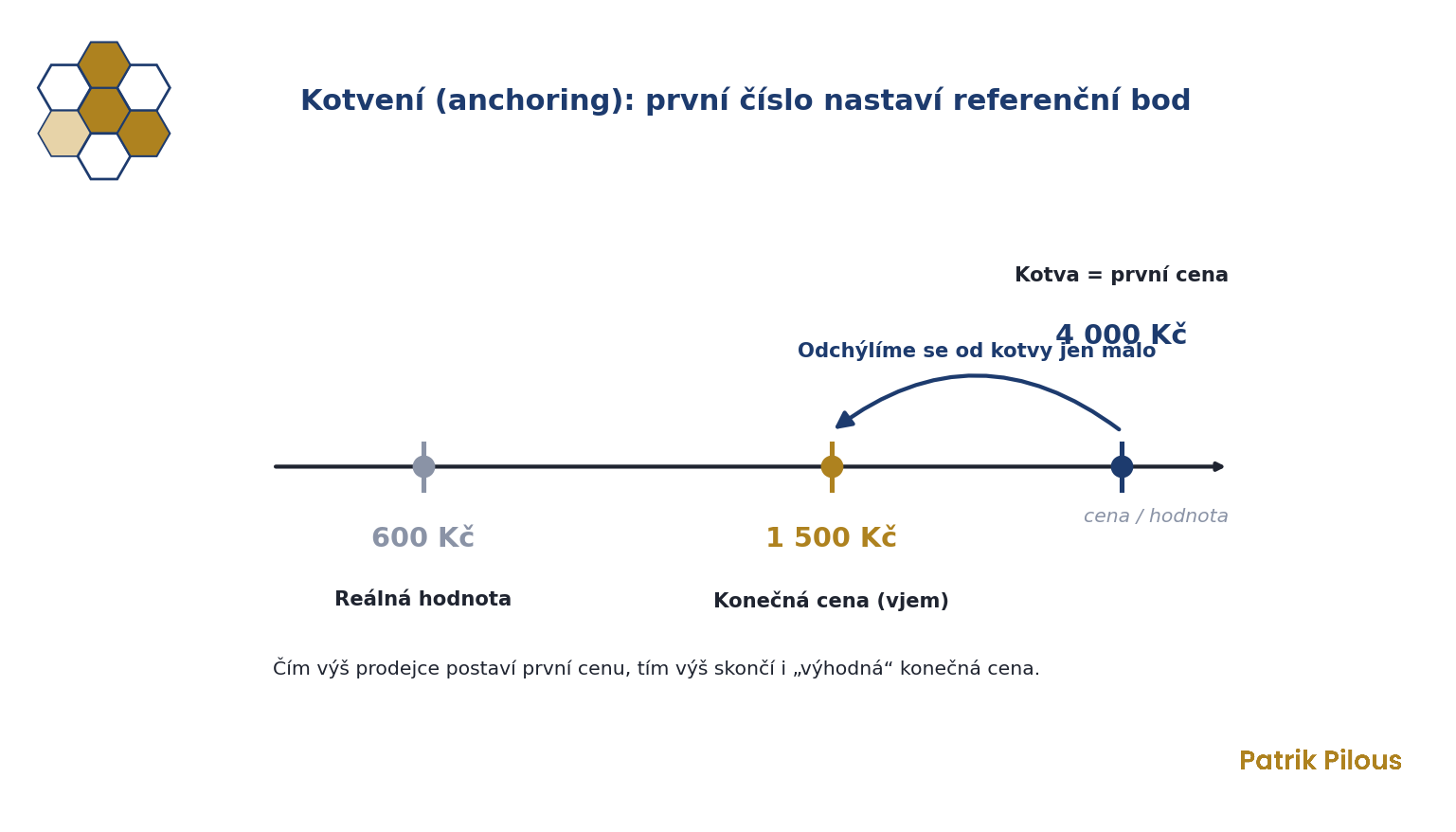
You know this from a beach holiday. You walk into a market, you like a leather bag and the seller throws out a price: 4,000 baht. At that moment something happened that you may not even have noticed. That number got stuck in your head as the first reference point. You start haggling, get down to 1,500 and walk away feeling victorious about how much you saved. Of course, anchoring in Asia has its own particular style, as prices are always inflated, especially for tourists.
But the bag was really worth maybe 600 baht. The seller did not win by haggling. He won with his first sentence. He set the anchor so high that even the “good” price you negotiated was still double the real value. And the whole time you felt you were the one in control.
This is exactly how anchoring works wherever money is involved. Whoever names a number first holds the price tag, which the two of you then simply adjust together. And the other side usually does not even realise it.
How anchoring works
The effect was described by the psychologists Daniel Kahneman and Amos Tversky. In a now legendary experiment, they spun a wheel of fortune secretly rigged to land on either 10 or 65. They then asked people what percentage of African countries were members of the UN. Those whose wheel landed on 65 gave much higher estimates than those who got 10. And this was despite the number on the wheel having absolutely nothing to do with the question.
That is the heart of the matter. An anchor works even when we know it is random and meaningless. The brain does not start calculating from zero. It starts from the last number it had available and only adjusts it up or down. That adjustment is almost always insufficient, so the result stays close to the anchor. It saves us energy, because working everything out from scratch would be exhausting. That is exactly why anchoring is so reliable and so easy to exploit.
Use in marketing
- Crossed-out price. 2,999 CZK (about 120 EUR) crossed out next to a new price of 1,799 CZK (about 74 EUR) does not just create a discount. It sets the expectation that “this product costs three thousand”. Without that anchor, 1,799 is just a number. With it, it is a saving of 1,200 CZK (about 49 EUR).
- The most expensive option first. Put the premium plan at the top or on the left. The customer anchors on it, and the middle option then looks like a sensible compromise, even though it is still more expensive than they originally planned to spend.
- Manufacturer’s recommended price. Even without a real discount, it is enough to show a higher reference price next to your own. This anchors the perceived value of the product higher than the customer would arrive at on their own.
- Quantity anchor. A sign saying “Maximum 12 items per person” demonstrably increases the average purchase. Twelve becomes the reference instead of one, and people buy closer to it.
- With services, set the anchor yourself. When you offer a consultation or a project, name the price first. If you wait for the client to name a number, you let the anchor be set by someone who wants to pay as little as possible.
How to defend yourself against anchoring
- Ask yourself a check question. “How much would I pay for this if I had never seen the crossed-out price?” This separates the value of the thing from the value of the impression.
- Find an independent reference. A price comparison site or price history gives you your own anchor. Once you have it, someone else’s anchor loses its power.
- Set a ceiling in advance. Before you walk into a negotiation or an online shop, decide how much you are willing to pay. Your own number protects you from someone else’s.
Where the ethical line lies
Anchoring is a legal and common tool, but it has limits. An invented “original price” that never actually applied is a misleading commercial practice in the Czech Republic. The Omnibus Directive also requires you to state the lowest price from the last 30 days when showing a discount. So anchor with reality, not fiction. A fake anchor sells in the short term, but in the long term it brings returns and bad reviews once the customer sobers up.
Frequently asked questions
What is anchoring?
A cognitive bias in which the first number stated becomes a reference point and influences all subsequent decisions, even when it has nothing to do with reality.
Who discovered the anchoring effect?
It was first described experimentally by the psychologists Daniel Kahneman and Amos Tversky in the 1970s, using an experiment with a wheel of fortune.
How does anchoring show up in pricing?
Most often through crossed-out prices, manufacturers’ recommended prices and the order of options in a price list, where a higher number shown first increases willingness to pay.
How can you defend yourself against anchoring?
Find an independent reference price and set your own price ceiling before you see the seller’s offer.
Euro amounts are approximate, converted at the Czech National Bank rate of 24.34 CZK per EUR on 29 October 2026.

