

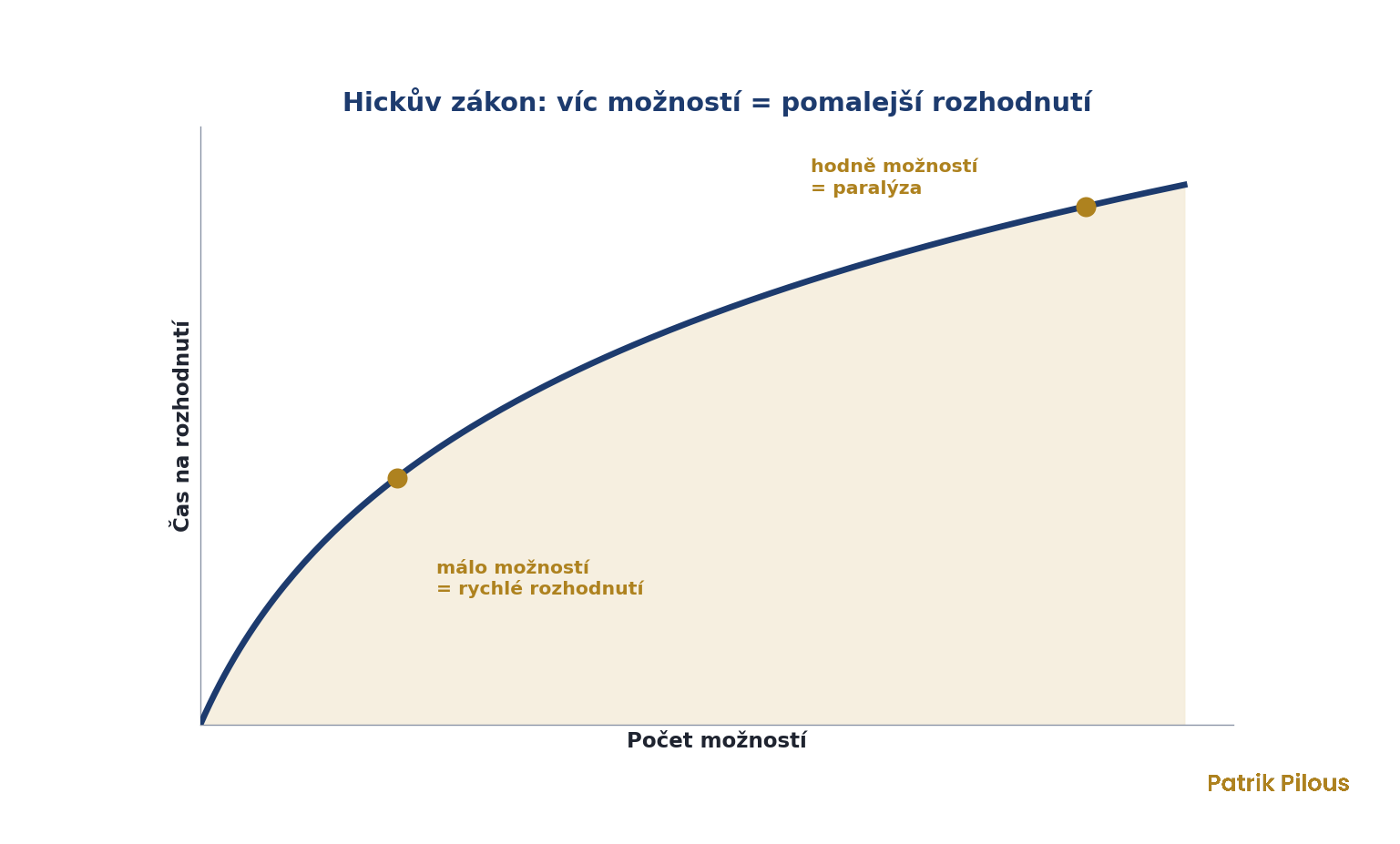
Hick’s Law (also known as the Hick-Hyman law) is the principle that the more options you give someone, the longer it takes them to decide. The increase is not linear but logarithmic: each extra choice adds decision time and mental effort, so beyond a certain point people do not choose better, only more slowly and more reluctantly. In UX design and marketing, the consequence is clear. An overloaded menu, a form with too many fields or five buttons side by side do not speed up the decision, they kill it. A few well-chosen options almost always lead to higher conversion than a long list of everything possible.
Classification
- Cause (Cognitive Bias Codex): Need to act fast
- Mental area: Decision-making
- Marketing function: UX and conversion
- Buyer journey: Decision
- Cialdini’s principles: not applicable
- System 1 / System 2: System 1 (fast, automatic)
In a nutshell
- What it is: more options = longer decisions and a higher mental load.
- Why we do it: the brain has to compare each choice with the others, and that takes time.
- Where you will see it: menus, forms, pricing pages, the number of CTAs, e-shop filters.
- How to use it: limit and group options so people can decide quickly.
A real-life story
The law was described by psychologists William Edmund Hick and Ray Hyman in 1952, when they measured how long it took people to react depending on the number of options they were choosing from. They found that decision time grows logarithmically with the number of choices. Hence the name Hick-Hyman law.
A classic everyday example is a menu with dozens of dishes. Instead of helping you, it overwhelms you, and in the end you go for something you know or for the waiter’s recommendation. A homepage with seven buttons of the same size works the same way. When you do not know where to start, you usually click nothing. Conversely, apps like Google bet on a single field and a single button, because they know a simple choice is made quickly and without friction.
How Hick’s Law works
Before every decision, the brain has to go through the individual options and compare them. The more there are, the more comparing it has to do, and the longer and more unpleasant the whole process becomes. When there are too many choices, the fear of making the wrong decision kicks in as well, and people prefer to do nothing. The law is closely related to the paradox of choice, which describes the paralysis caused by too many options, and to the default effect, because a well-set default cuts decision time to zero.
Use in marketing and on websites
- Limit the number of CTAs. One main action per page. When users have one clear step, they take it.
- Shorten your forms. Every extra field reduces completion. Ask only for what you really need.
- Split up your menu. Group a long menu into logical categories so people do not have to choose between twenty items at once.
- Recommend an option. A “most popular” label on your pricing page reduces the decision load and directs attention.
- Filter smartly. In an e-shop, help customers narrow their choice with filters and sorting so they do not get lost among thousands of products.
How to protect yourself
- Spot fake variety. When you are offered too many variants, it may be deliberate, so that you decide based on the seller’s recommendation.
- Narrow the choice yourself. Set 2 to 3 criteria in advance and filter out the rest.
- Do not give up on the decision. Overload tempts you to put things off. Choose good rather than perfect.
How it connects with other biases
Hick’s Law and the paradox of choice are two sides of the same coin. Hick describes how more options mean longer decisions, and the paradox of choice adds that with too many options we often do not choose at all. On a pricing page, you can solve this by combining it with the compromise effect and the default effect. Offer three variants instead of ten, mark one as recommended, and the decision becomes easy and quick.
Frequently asked questions
What is Hick’s Law?
A principle stating that the time needed to make a decision grows with the number of options offered, and it does so logarithmically.
Who discovered Hick’s Law?
Psychologists William Edmund Hick and Ray Hyman in 1952, which is why it is also called the Hick-Hyman law.
How can you use Hick’s Law on a website?
Limit the number of options and CTAs, shorten forms, split the menu into categories and recommend one option so users can decide quickly.

