
The sunk cost fallacy is a cognitive bias in which we carry on with something only because we have already put money, time or effort into it. That investment is gone and will not come back, whatever we do. Even so, we feel pushed to continue, even when stopping would be the more sensible choice. “I’ve put so much into this, I can’t back out now.” It happened to me, for example, when I started investing. I picked a stock. I told myself it was a good one. Then, as it fell, I kept buying more. Once, right up to a complete crash. When I read more about it, I found it is a very common effect among beginner investors.
Classifying the cognitive bias
- Cause (Cognitive Bias Codex): Need to act fast
- Mental area: Decision-making
- Marketing function: Price and value (and retention)
- Customer journey: Post-purchase and retention
- Cialdini’s principles: not applicable
- System 1 / System 2: System 1 (plus later rationalisation)
In brief
- What it is: we stick with something because of what we have already spent, not because of its future benefit.
- Where you meet it: a subscription you don’t use, an unfinished project, a long relationship, food you haven’t finished.
- How to use it: remind customers how much they have already invested in their relationship with the brand.
A real-life story
Petr bought an annual gym membership for 5,000 CZK (about 210 EUR). After a month he realised he didn’t enjoy it and hardly went anyway. Still, he forces himself to go, because “he’s not going to let it go to waste”. If he had got the same membership for free, he would have stopped long ago. What keeps him going is not the joy of exercise but a reluctance to “throw away” money that is spent either way. Whether he goes or not, the 5,000 CZK (about 210 EUR) is gone.
You know the same logic from the cinema. Twenty minutes in, the film is boring, but you stay because “I paid for the ticket, after all”. Sitting through another two hours will not get you the ticket price back, though. You just add lost time to the money already spent.
If we look at the effect from the other side, it is easy to see that people often don’t value things they get for free. That is one reason I am not a fan of the Czech healthcare system, which in some areas provides a very average service with poor infrastructure free of charge to people who don’t value it at all.
Fun fact: the most expensive example in history is named after an aircraft. The British and French governments kept pouring money into the supersonic Concorde even when it was clear it would never pay off, precisely because they had already invested so much in it. That is why economists sometimes call the sunk cost fallacy the “Concorde fallacy”.
How the sunk cost fallacy works
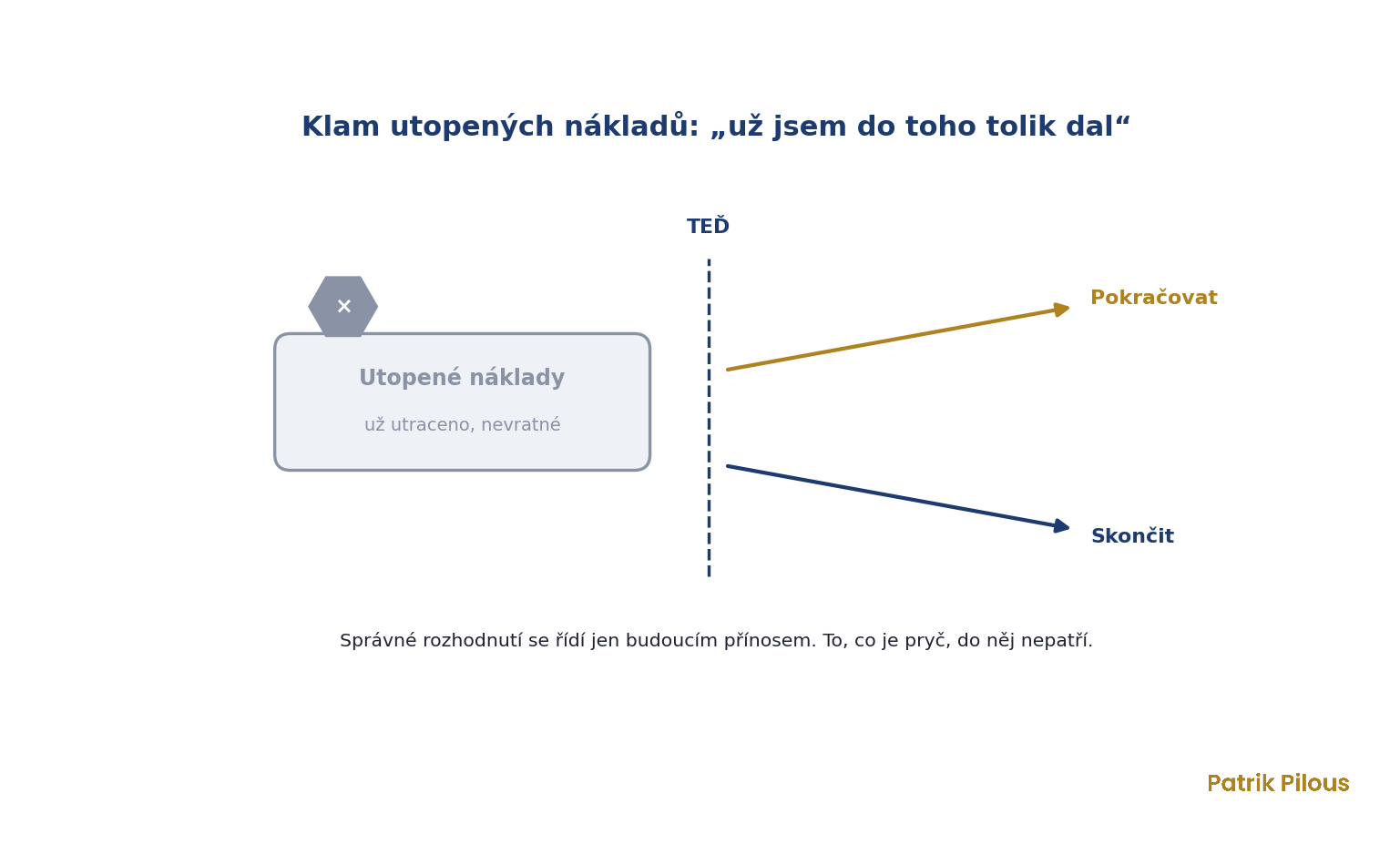
Rationally, every decision should be guided only by what it will bring in the future. Past costs cannot be recovered, so they have no place in the decision at all. Our brain, however, cannot separate the two. First, it cannot bear the feeling of loss described by loss aversion. We see ending something unfinished as admitting a loss, and we avoid that. Second, we want to be consistent in our own eyes and don’t want to admit that an earlier decision was wrong.
In the 1980s, the researchers Arkes and Blumer demonstrated this with a simple experiment using theatre season tickets. People who paid full price for their season ticket attended performances more often than those who got a discount, even though everyone had the same tickets. The difference came not from the value of the experience but from the size of the sunk amount. The IKEA effect is closely related: we put our own work into something, which makes it all the harder to give up.
Use in marketing
- Loyalty programmes. Collected points and progress through tiers keep customers with a brand, because leaving means “losing” what they have already built up.
- Subscriptions and memberships. The more customers set up and upload in an app, the harder it is for them to cancel. Invested time is a sunk cost too.
- Progress and unfinished tasks. Indicators such as “your profile is 80% complete” push people to finish so their earlier effort does not go to waste. This is also linked to how people make decisions based on reference points.
- Prepaid credit. Customers almost always spend credit they have topped up, because they don’t want it to expire.
- Step-by-step onboarding. The further you guide customers, the stronger their sense of invested effort and the less they want to leave.
- The ethical line. Keeping customers only through sunk costs is a short-term approach. If the product does not deliver value, sooner or later they will leave, and with a bitter aftertaste.
How to protect yourself against the sunk cost fallacy
- Ask forwards, not backwards. “If I hadn’t put anything into this yet, would I start it today?” If not, it is time to stop.
- Separate what is spent from what lies ahead. Money and time that are gone have no place in the decision. Decide only on the basis of what it will bring next.
- See stopping as a gain. Ending something bad is not a defeat but a way to free up resources for something better.
Remember one sentence: sunk costs are gone either way. The only thing you can influence is what you do now. Anyone who learns to decide based on the future rather than the past will save a lot of money, time and stress.
Frequently asked questions
What is the sunk cost fallacy?
A cognitive bias in which we carry on with something only because of the money, time or effort already invested, even though stopping would be more sensible.
What is the Concorde fallacy?
Another name for the sunk cost fallacy, after the supersonic Concorde aircraft, which kept receiving investment even when it was clear it would not pay off.
How can you protect yourself against the sunk cost fallacy?
Ask whether you would go into it again if you hadn’t invested anything yet, and decide only on the basis of future benefit, not the money and time already spent.
Euro amounts are approximate, converted at the Czech National Bank rate of 24.34 CZK per EUR on 29 October 2026.

