

Survivorship bias is a cognitive bias in which we judge by those who got through something successfully and overlook those who failed, simply because we no longer see them. We look only at the “survivors” and draw conclusions about the whole group from them. Yet those who dropped out along the way would tell us a completely different story.
Classification of the cognitive bias
- Cause (Cognitive Bias Codex): Not enough meaning
- Mental area: Probability judgement
- Marketing function: Probability and risk
- Buyer journey: across all stages (analysis and strategy)
- Cialdini’s principles: not applicable
- System 1 / System 2: System 1 (fast, automatic)
In brief
- What it is: we see only successes, because the failures have disappeared from view.
- Where you’ll encounter it: “this is how they got rich”, guides from successful people, reviews only from satisfied customers.
- How to use it: show references, but for your own purposes also count those who didn’t finish.
A real-life story
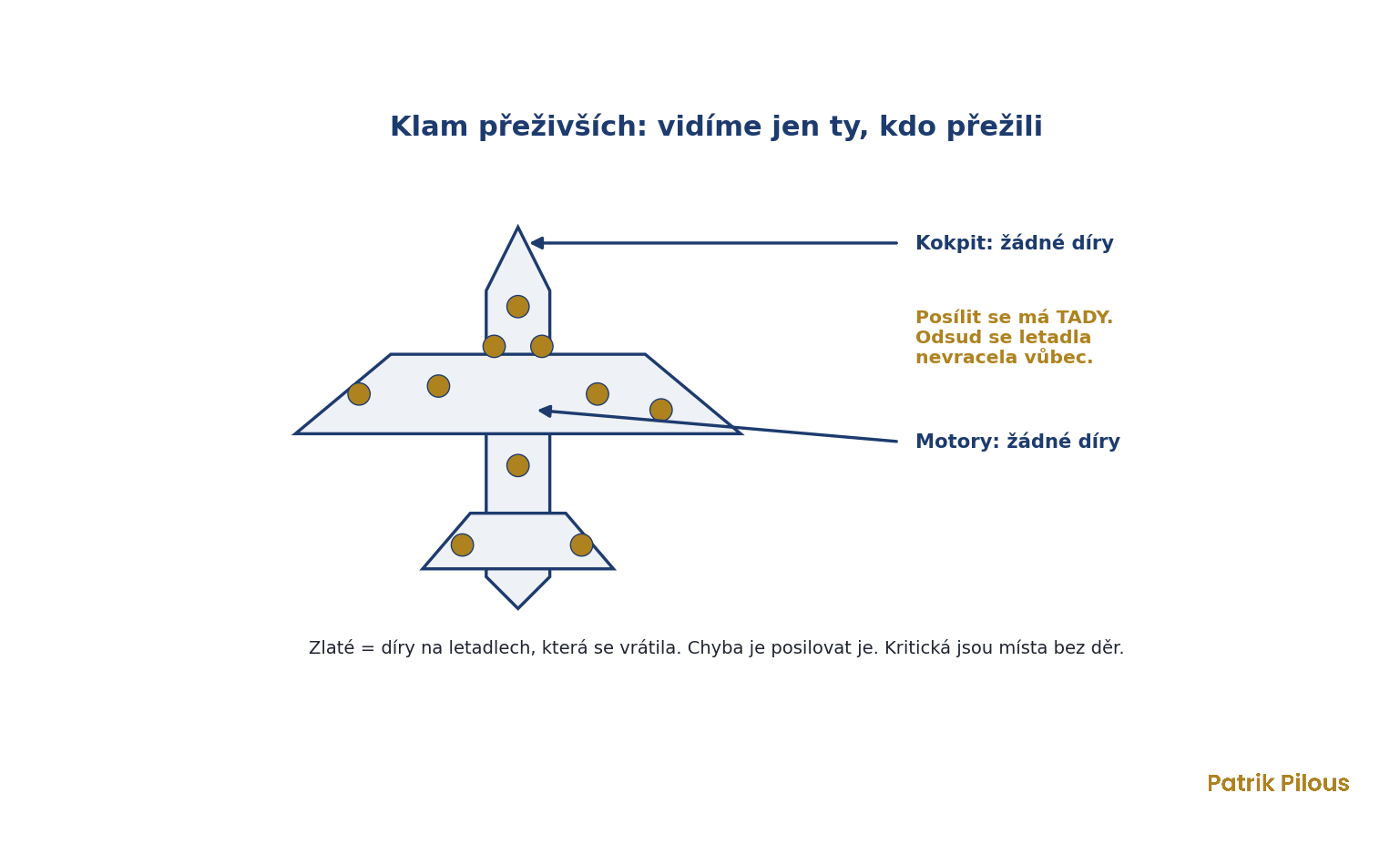
During the Second World War, the US military was working out how to improve bombers that came back from raids riddled with bullet holes. The generals proposed adding armour where there were the most holes, namely the wings and the fuselage. It sounded logical. The mathematician Abraham Wald, however, turned the whole argument on its head. He said the armour should go where there were NO holes on the returning aircraft, namely the engines and the cockpit. Why? Because planes hit in the engine or the cockpit simply didn’t come back. The military saw only the ones that survived and wanted to reinforce them in places that clearly hadn’t prevented survival.
Plenty of people still think exactly like this today. Imagine Bára, who wants to start a business and reads one success story after another. “He dropped out of school and built a billion-dollar company.” She concludes that school is pointless and all you need is courage. What she doesn’t see are the thousands of people who dropped out, took the risk and ended up in debt. Nobody writes articles about them. The sample Bára is judging from consists only of survivors.
Fun fact: you’ll find the same bias in adverts for investment funds. Funds that lost money over the long term are quietly closed or merged by the provider, and only the ones that survived and made money are advertised. The average performance of the funds “on offer” therefore looks better than it really was.
How survivorship bias works
The brain works only with the data it has in front of it. And what we see is almost always just the successes, because they are displayed, shared and sold. Failures vanish quietly. This creates a distorted sample from which we draw conclusions about the whole, without realising that a huge part of the story is missing. Researchers call this the missing “invisible graveyard” of data.
It is most treacherous with guides to success. If ten billionaires get up at five in the morning, that doesn’t mean getting up at five makes you a billionaire. Millions of people may get up just as early without it helping them at all. Without those who failed, any “rule of success” is just an impression. This is linked to overestimating our own judgement, as described by the Dunning-Kruger effect.
Use in marketing
- References and case studies. Showcase successful customers, that’s legitimate. But for yourself, also account for those who left, otherwise you’ll distort your own data.
- Reviews. It’s mostly the satisfied and the angry who speak up, and the silent majority is missing. Actively ask for feedback from those who didn’t complete a purchase, too.
- “Best practices” from the winners. Copying only what market leaders do is a trap. Those who went bust may have done exactly the same.
- Competitor analysis. Don’t look only at the brands that made it. Find out who disappeared from your field and why. That’s often where the more valuable lesson lies.
- Honest testimonials. A collection of nothing but five-star ratings seems unbelievable. A little criticism paradoxically increases credibility, because it breaks the impression of a hand-picked sample.
- Your own decisions. When you build a marketing strategy based on “what works for others”, ask who it didn’t work for and why.
How to guard against survivorship bias
- Look for the missing sample. “Who am I not seeing in this data?” Those who left, went bust or stayed silent are just as important.
- Don’t trust guides to success. Ask whether those who failed did the same thing.
- Ask about the base. How many people tried it in total, not just how many of the visible ones succeeded.
Survivorship bias is insidious precisely because missing data doesn’t shout. The best defence is the habit of asking who is missing from the story. Once you have that habit, you’ll start making decisions based on the whole picture, not just the part on display.
Frequently asked questions
What is survivorship bias?
A cognitive bias in which we judge only by successful cases and overlook unsuccessful ones, because we no longer see them. As a result, the sample is distorted.
Where does the aircraft example come from?
From the mathematician Abraham Wald, who during the Second World War advised armouring the parts of bombers that showed no hits, because planes hit there didn’t return.
How does survivorship bias show up in marketing?
Through guides from successful people, collections of nothing but positive reviews, and copying market leaders without looking at those who failed using the same approach.

