

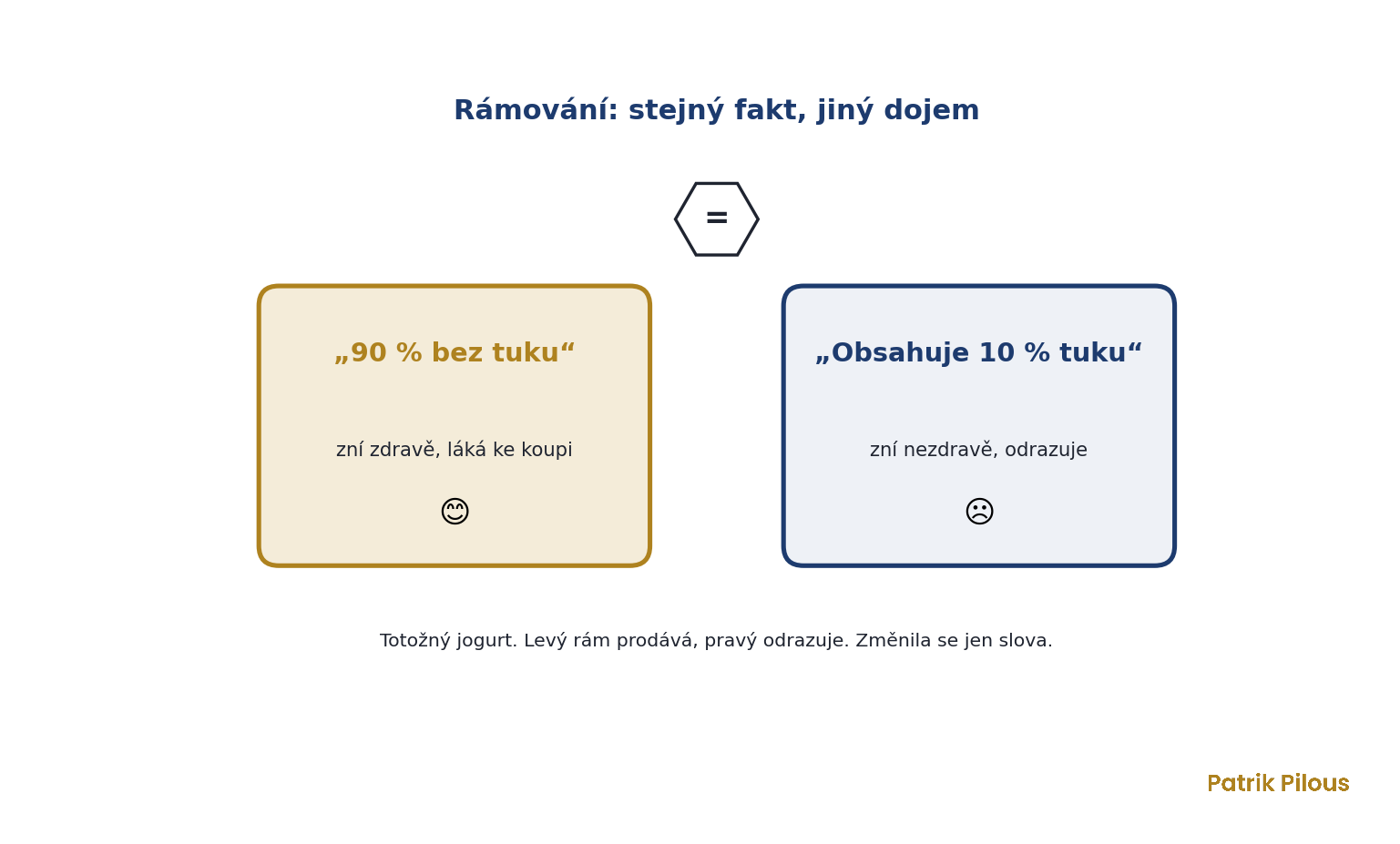
The framing effect is a cognitive bias in which we make different decisions depending on how the same information is presented. The fact stays exactly the same, only the words and context change, and yet our choice changes. “90% success rate” and “10% failure rate” mean exactly the same thing, but the first sounds good and the second puts people off.
Classification of the framing cognitive bias
- Cause (Cognitive Bias Codex): Too much information
- Mental domain: Decision-making and perception
- Marketing function: Price and value (and communication)
- Customer journey: Consideration and decision
- Cialdini’s principles: not applicable
- System 1 / System 2: System 1 (fast, automatic)
In a nutshell
- What it is: the same information presented differently leads to a different decision.
- Where you’ll see it: “90% fat-free”, “you’ll save” vs “you’ll lose”, a daily price instead of a yearly one.
- How to use it: choose a frame that highlights the gain and plays down the cost, but stay truthful.
A real-life story
Kahneman and Tversky asked people to decide on a treatment for a disease. One group was told that thanks to the treatment “200 out of 600 people will survive”. The other was told that “400 out of 600 people will die”. It is exactly the same number. Yet the first group approved the treatment far more often, because it was framed as saving lives, not as a loss. Doctors, students and statisticians alike all fell for a mere rewording.
You know it from shopping too. Minced meat labelled “80% lean” sells better than “20% fat”, even though it is the same product. Or subscriptions: “3,588 CZK (about 150 EUR) a year” sounds expensive, but “only 299 CZK (about 12 EUR) a month” or even “less than 10 CZK (about 0.41 EUR) a day” sounds like next to nothing. The number is the same, but the context is different.
How the framing effect works
We don’t perceive the world in absolute values, but in relation to a reference point and to whether something looks like a gain or a loss. The frame sets that reference point for us. Because a loss hurts us more than an equal gain pleases us (which is the core of loss aversion), the same thing presented as “you won’t lose” feels different from “you’ll gain”. Framing is therefore closely related to anchoring: both work with what we relate the information to.
Use in marketing
- Emphasise the positive side. “90% of customers recommend us” instead of “10% don’t recommend us”. The same data, a better impression.
- Break down the price. A daily or monthly price sounds friendlier than a yearly amount. “For the price of one coffee a day.”
- Frame it as what the customer will lose. “Without this, you’re missing out on…” works better than “you’ll get…”, because it plays on the fear of loss.
- Work with the reference point. “30% off” vs “you’ll save 900 CZK (about 37 EUR)”. For cheaper goods a percentage works better, for more expensive ones an absolute amount.
- The frame in your claim and slogan. I discuss how to choose the right tone in my article on advertising slogans. If you have the most expensive product in its category, it is worth saying that it belongs to a different category. When we were selling a very expensive insulating paint, we didn’t call it paint (people aren’t used to paying tens of thousands for paint). We called it insulation, because there that price is perfectly normal.
- Test two wordings. An A/B test of two frames for the same offer often moves conversion more than changing the product.
How to protect yourself from the framing effect
- Reword it yourself. Hear “90% fat-free”? Tell yourself “contains 10% fat” and check whether you still like it.
- Convert to absolute numbers. Turn percentages, daily prices and “up to” claims into the actual yearly amount or count.
- Look for what the frame hides. Every frame highlights something and hides something else. Ask about the other side.
Frequently asked questions
What is the framing effect?
A cognitive bias in which we make different decisions depending on how the same information is presented, even though the facts stay the same.
What is an example of the framing effect?
“90% fat-free” versus “contains 10% fat”, or “200 out of 600 will survive” versus “400 out of 600 will die”. The same data, a different decision.
What is the difference between framing and anchoring?
Anchoring sets a reference number, framing sets the tone (gain versus loss). They often work together.
Euro amounts are approximate, converted at the Czech National Bank rate of 24.34 CZK per EUR on 29 October 2026.

