
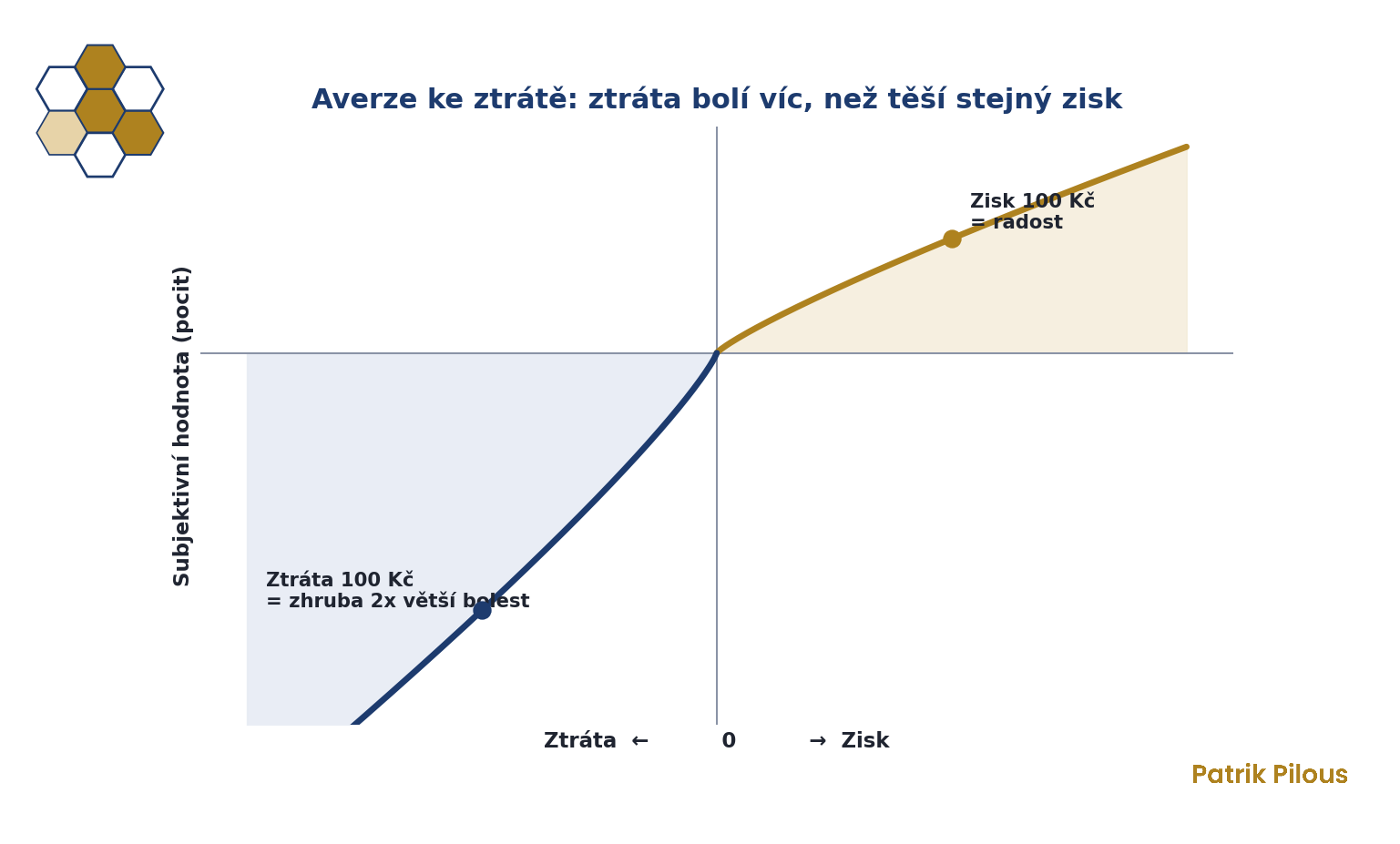
Loss aversion is a cognitive bias in which a loss hurts us roughly twice as much as an equal gain pleases us. Losing a thousand crowns feels noticeably worse than finding a thousand crowns, even though the amount is the same. Because of this, we tend to make decisions to avoid losing anything rather than to gain something.
Classification of the cognitive bias
- Cause (Cognitive Bias Codex): Need to act fast
- Mental area: Decision-making
- Marketing function: Price and value
- Buyer journey: Decision
- Cialdini’s principles: Scarcity
- System 1 / System 2: System 1 (fast, automatic)
In a nutshell
- What it is: the fear of loss is a stronger motivator than the prospect of gain.
- Where you’ll see it: “don’t miss out”, countdowns, free trials, extended warranties.
- How to use it: frame your offer as what the customer will lose, not just what they will gain.
A real-life story
Imagine I offer you a coin-toss bet. If it lands heads, I give you 1,000 CZK (about 41 EUR). If it lands tails, you give me 1,000 CZK (about 41 EUR). The odds are fifty-fifty and fair. Yet most people turn it down. For the bet to become tempting, I would have to offer roughly 2,000 CZK (about 82 EUR) for a win against the risk of losing 1,000 CZK (about 41 EUR). That is exactly the ratio in which we weigh the pain of a loss against the joy of a gain.
The same force keeps people subscribed. You try an app free for 30 days, you get used to it, and when the trial is about to end, cancelling suddenly means “losing” something you already have. That hurts more than deciding never to start it. Companies know this, which is why they hand out trials. They are not betting on you falling in love with the product, but on you not wanting to lose it.
How loss aversion works
It was described by Daniel Kahneman and Amos Tversky in what is known as prospect theory. They found that we do not measure value in absolute terms, but as a gain or loss relative to a reference point. And the curve of pain from a loss is steeper than the curve of joy from a gain. Hence the roughly twofold difference.
Closely related is the endowment effect: things we already hold or have tried, we value more highly because we would not want to lose them. The IKEA effect rests on the same foundation, where we value things more when we have put our own work into them.
Use in marketing
- Frame the loss, not the gain. “You are losing 3,000 CZK (about 120 EUR) a year” works better than “you will save 3,000 CZK (about 120 EUR) a year”. The same number, a stronger motivation.
- Trials and samples. Once customers have something, they do not want to lose it. A free trial is a tool of loss aversion, not generosity.
- Time-limited offers. A countdown and “today only” trigger the fear of missing out. It works best combined with anchoring, where a crossed-out price sets a reference the customer would “lose”.
- Guarantees and refunds. They remove the buyer’s fear of loss and, paradoxically, increase sales, because you take on the risk.
- Extended warranties and insurance. They sell peace of mind, the certainty that you will not lose the product. Emotion, not calculation.
How to protect yourself from loss aversion
- Reframe the decision. Ask yourself: “If I didn’t have this yet, would I buy it today at full price?” If not, you are only holding on to it out of fear of loss.
- Think in absolute numbers. Separate the emotion of the word “loss” from the actual amount and benefit.
- Keep an eye on subscriptions. Go through what you are paying for only because cancelling feels like a loss.
Frequently asked questions
What is loss aversion?
A cognitive bias in which a loss triggers a stronger negative feeling than the joy of an equal gain, in a ratio of roughly two to one.
Who described loss aversion?
Daniel Kahneman and Amos Tversky, as part of prospect theory, in the late 1970s.
What is the difference between loss aversion and the endowment effect?
Loss aversion is a general tendency to avoid losses, and the endowment effect is one of its manifestations: we value something we already own more highly because we do not want to lose it.
How can you protect yourself from loss aversion?
Reframe the decision by asking whether you would buy the item again at full price, and think in real amounts instead of emotions.
Euro amounts are approximate, converted at the Czech National Bank rate of 24.34 CZK per EUR on 29 October 2026.

