
Maps, Firmy.cz and local search
Local SEO
Local SEO is the work of making sure people near you can find you: in Google Maps and on Mapy.com, in the results of Google and Seznam (Czech search engine), and now also in AI answers. It rests on business profiles, reviews, the same business details everywhere on the internet, and a website that supports local search.
I have handled local SEO for large brands with hundreds of map listings and for businesses with a single location. For companies, I audit their profiles and website, correct their details, adjust the website and set up a simple system for asking for reviews. Here I describe how I work, what works differently in the Czech Republic compared with foreign guides, and where businesses most often lose customers from their area.
What local SEO is made of

Google Business Profile
A verified and fully completed profile. Google takes details from it for Google Maps and for local search results.

Firmy.cz and Mapy.com
Seznam's business directory, which appears in Seznam search and on Mapy.com. A listing is free and competitors often neglect it.

Reviews and replies
Regular reviews from real customers and factual replies, including to critical ones. According to Google, more positive reviews can improve your ranking.

The same details everywhere
Name, address and phone number in one form on the website, in profiles, in directories and on social media.

A website for local search
A page for each location, the address and a map in a visible place, structured data, and texts about your services in that area.

Local mentions
Links and mentions from local media, the municipal website, associations and partners. They increase what Google calls a business's prominence.
Who have I provided website and SEO consulting for?


VYNIKAJÍCÍ
Who local SEO pays off for and who it doesn't
Local SEO pays off most for businesses that customers visit or that travel to customers. Restaurants, cafés, hairdressers, medical practices, car repair shops, gyms and shops with a physical store. The same goes for tradespeople and on-site services, such as plumbers, electricians, floor fitters or painters and decorators. The vast majority of their customers come from the local area.
An e-shop that ships goods across the whole country is a different case. For it, maps are only an extra, and what matters is classic SEO, category structure, content and links. A map profile is still worthwhile for businesses that are not limited by location. My own consultant profile was shown to roughly 800 people for queries such as SEO or SEO consultant, even though my clients are all over the Czech Republic.
In Search Console I can see that people come to this page with queries such as local SEO for restaurants, for plumbers, for roofers or for hairdressers. Business owners want to know how it works in their particular field, which is why I cover restaurants and tradespeople separately below.
Where local search is decided in the Czech Republic
Foreign guides only deal with Google. In the Czech Republic, you have two systems side by side. Google takes details from Google Business Profile and shows them in Google Maps and in search results, and its AI, Gemini, can also use data from Google Maps. Seznam takes details from the Firmy.cz directory and shows them in its search and on Mapy.com, which is what the former Mapy.cz has been called since 2025.
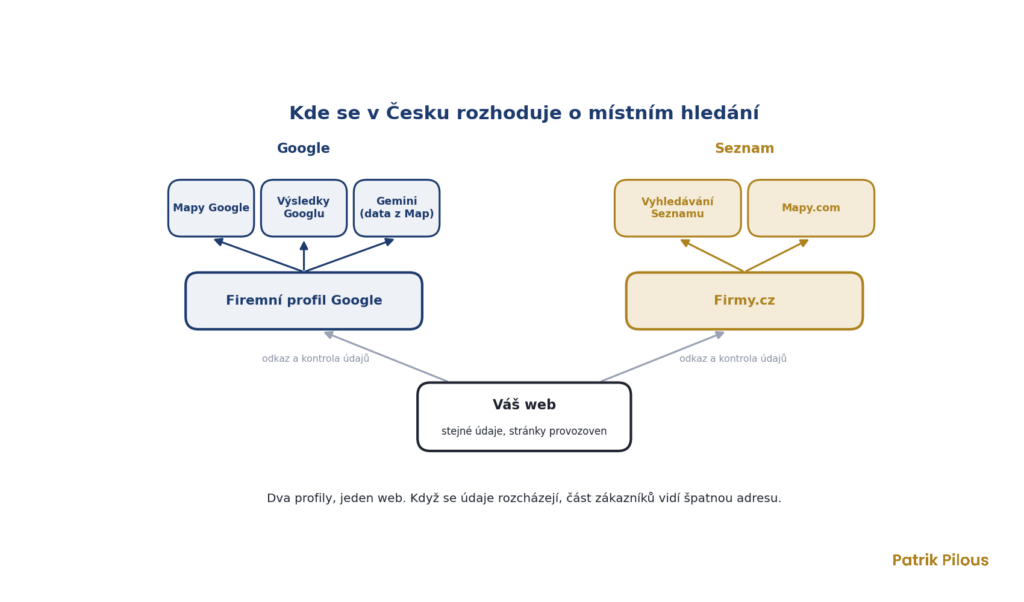
Your website connects them. Both search engines read it, compare it with the profiles and use it to check that the details match. A business that has only completed its Google profile and has an old Firmy.cz listing from when it was based elsewhere shows some customers the wrong address.
Google Business Profile step by step
Google Business Profile, formerly Google My Business, is the foundation. Google itself says that verified businesses are more likely to appear in results. When setting up and cleaning up a profile, I follow this order.
- Verification. Without a verified profile, you have no control over your details and anyone can suggest a change.
- The name as it really is. The same as on your sign and on your website. Keywords, the city or a slogan do not belong in the name, and Google explicitly prohibits this in its guidelines.
- Categories. As few categories as possible, but accurate ones. They describe what the business is, not everything it offers.
- Address or service area. If you travel to customers and do not receive them at your premises, you should hide your address and set the area you serve.
- Opening hours, including special hours. Public holidays and unexpected closures. A customer who arrives at a closed door will write a review.
- Services, products and attributes. Parking, wheelchair access, card payments. Google counts them among the details a profile should have completed.
- Photos and videos. Your real premises, team and work. Customers can spot stock photos.
A profile is not a one-off job. I check it after every change in the business and regularly even without one, because any member of the public can suggest edits to the profile.
Firmy.cz, the profile foreign guides forget about
Firmy.cz is run by Seznam and, according to its help pages, contains over 740,000 business profiles in more than 3,600 industry categories. A basic listing is free. The profile is shown not only on Firmy.cz but also in Seznam search and on Mapy.com, so for some Czech customers it is the first thing they see about you.
The process is the same as with Google. Claim the profile, correct the details, add a description, photos and opening hours. Firmy.cz has one practical advantage with disputed reviews. A business can ask the reviewer for clarification, which hides an unclear review less than 90 days old for 30 days.
Treat other directories with caution. Most of them bring nobody any customers and some are pure spam. Only industry directories that people in your field genuinely use are worth it, typically in healthcare or the trades.
What decides your position in maps
Google is clear about ranking in local results. What matters is relevance (how well the profile matches the search term), distance from the person searching, and the business’s prominence. According to Google, prominence also includes the number of websites linking to the business and the number and rating of reviews. According to Google, a better position cannot be requested or bought.
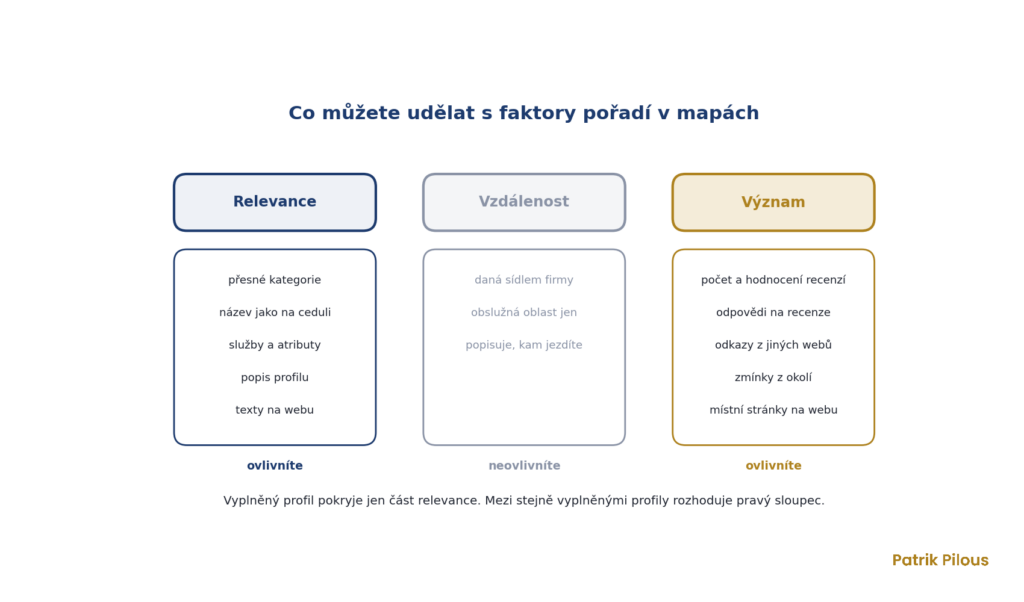
You cannot change distance. You can change relevance and prominence, and that is where the work needs to be spread. Most businesses stop at a completed profile, which only covers part of relevance. Reviews, links, mentions and the website are often left undone, and that is exactly where the decision is made between businesses with equally well completed profiles.
Reviews: how to ask for them within the rules
You have to ask for reviews. A satisfied customer usually won’t think of it on their own, but a dissatisfied one will. The simplest way is a link or QR code straight from your Google Business Profile. Send the link by email after a completed job, and put the QR code on the counter, on the receipt or on your business card.
Watch out for one thing that even some experienced consultants recommend. Google’s rules prohibit asking only customers who seem satisfied for a review. Google Maps explicitly does not allow selectively soliciting positive reviews. Discounts or gifts in exchange for reviews, reviews from employees and discouraging negative reviews are also prohibited. That is why I recommend asking all customers at the same point, for example when handing over a job or in an email after a purchase.
Sellers who also publish customer reviews on their own website have an additional obligation under the Consumer Protection Act (zákon o ochraně spotřebitele). Under Section 5a(5), they must state whether and how they ensure that reviews come from people who actually bought or used the product or service. If they do not verify them, they must say so. Under Annex 1 of the same Act, publishing fake reviews or commissioning someone else to write them is a misleading commercial practice, and it is supervised by the Czech Trade Inspection Authority (Česká obchodní inspekce).
How to reply to negative reviews
You are not writing a reply to a negative review for the reviewer. You are writing it for the dozens of people who will read it afterwards and decide, based on the tone of your reply, whether to call you. Google advises replying politely and briefly, admitting a mistake where the business made one, not sharing private details, and offering a solution outside the public discussion, by email or phone.
If a review describes what happened untruthfully, reply factually and stick to the facts, without irony. If it breaks the rules, for example it is an insult or a review from a competitor, report it. On both Google and Firmy.cz, you can do this directly from your profile. You cannot delete a review just because you don’t like it.
A website that helps maps
The most common local SEO mistake I see is a profile polished down to the last detail and a website that says nothing about the location. The address only in the footer, no map, no mention of the city in the title or heading. Yet the website is the only place where you control absolutely everything, and queries that include a city name are answered mainly by website pages, not maps.
For local clients, I most often make five changes to the website. None of them requires a new website. Usually it is enough to adjust the template and a few pages.
- A page for each location with its own address, phone number, opening hours, map and directions on how to get to you.
- The city or district in the page title (title) and in the heading where it makes sense, and service texts written the way people in that area search for them.
- LocalBusiness structured data. Google uses it to recognise opening hours, business departments and other details.
- A link from your Google and Firmy.cz profiles to the page of the specific location, not just to the homepage.
- A fast website that works on mobile, because local search happens mainly on phones.
What I do not do is build dozens of almost identical pages such as “plumber Prague 1”, “plumber Prague 2” through to “plumber Kladno”. Google’s spam policies list these as doorway pages, and Google also treats blocks of text listing the towns a page wants to rank for as spam. I write more about how I build individual pages under on-page SEO, and about structured data in the article Structured data.
The same details everywhere: NAP in practice
NAP stands for name, address, phone. These details must be identical everywhere: on the website, in both profiles, on Facebook, in industry directories and in your email signature. A different house number, an old phone number or two different company names confuse both search engines and customers.
The most common source of inconsistency is the gap between the registered company name and the brand. The website says Kavárna U Mostu, the directory says Novák a syn s.r.o. and Facebook uses an abbreviation. During an audit I therefore list every place where the business appears and align them all with the shop sign and the website.
Local SEO for restaurants and cafés
For restaurants, the decision to visit is often made directly in the map. Someone looking for somewhere to eat is on their phone near you and chooses based on what they see in the profile: photos of the food and interior, ratings, opening hours and the menu.
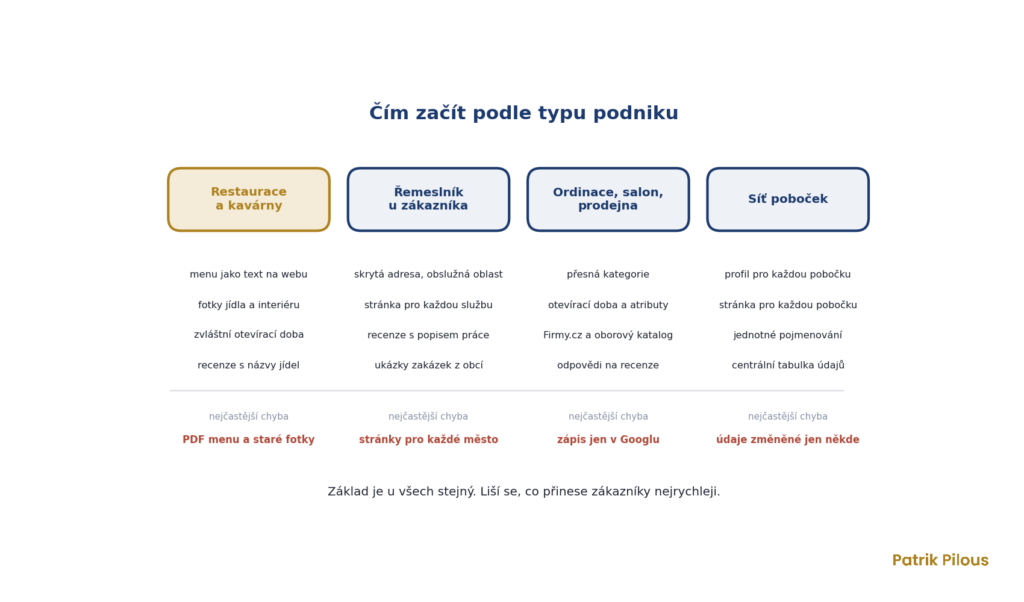
The menu is what gets forgotten most. Google Business Profile has a menu editor and can show popular dishes and a link to the menu on your website. Google can also take menu details directly from your website. That is why I recommend having the menu on your website as plain text, not as a PDF or a photo, and updating it on the same day as in the restaurant.
Then there are reviews. For restaurants, people write about specific dishes, the service and prices, and other guests choose based on that. Special opening hours for public holidays, up-to-date photos from throughout the year and an equally well-kept profile on Firmy.cz all help. And one more thing: when someone asks an AI assistant for a good restaurant nearby, Gemini with Google Maps grounding can show exactly those ratings, photos and opening hours.
Tradespeople and on-site services
A plumber, electrician or roofer usually has no premises that customers visit. In line with Google’s guidelines, they therefore hide the address in their profile and set a service area, meaning the towns or districts they travel to. A service area does not mean they will appear everywhere within it, though. Distance from the person searching still matters, which is why the website and reviews do more of the work here than for a café on the main square.
On the website I create a page for each main service, not for each town. I mention the towns the tradesperson actually travels to naturally and with real content, such as an example of a job from that place. Reviews in which the customer describes in their own words what was done and where are very valuable. Google’s policies do not allow you to dictate the content or the rating, but it is enough to ask straight after handing over the job, while the work is fresh in their mind. Add photos of finished jobs to the profile and the website.
Businesses with multiple locations
For chains and branch networks, local SEO is mainly about management. Each branch needs its own verified profile, its own page on the website with the same details, and consistent naming across all profiles. When opening hours change across the whole network, they must change everywhere at once, otherwise within a week you have a mess that takes months to clean up.
A central spreadsheet of all branches with the correct details helps, along with regular checks that no member of the public has changed them. For networks with hundreds of listings, the whole job depends on this.
Local SEO and AI assistants
Today you can also ask ChatGPT, Gemini or Google’s AI Mode about local services. For Gemini, Google offers Google Maps grounding with data on more than 250 million places, including reviews, photos, addresses and opening hours. Apps that use this grounding can show Google Maps data directly in the answer, without the person opening a map.
This means you do not need to prepare for AI separately. The same basics apply as for maps: a complete profile, the same details everywhere and reviews describing a specific experience. For other assistants, such as ChatGPT, what your website and other sources say about you matters more. I explain how to get into AI answers beyond maps on the GEO page.
The most common mistakes I find during audits
When auditing local businesses, the same five mistakes keep coming up. None of them is expensive to fix; nobody is just looking for them.
- Unverified or duplicate profile. The business has two listings, one old and one new, and the reviews are split between them.
- Keywords in the business name. Under its guidelines, Google may suspend the profile for this.
- Nobody manages Firmy.cz. Six months after the move, the listing still shows the old address.
- Passivity with reviews. The business does not ask for them and does not respond to criticism, or responds aggressively.
- A profile without a website. The maps listing is fine-tuned, but the website says nothing about the location and services, so the business loses out on searches that include the town name.
You can find all five mistakes yourself. Go through your profiles on Google and Firmy.cz through a customer’s eyes, compare the address and phone number with your website, and count how many reviews from the past year the business has responded to.
How I do local SEO for clients
I start with an analysis. I find out what people in your industry and town search for and how you and your competitors appear for those searches on Google and Seznam (Czech search engine). The foundation is keyword research narrowed down to local searches. Then I go through the profiles, directories and website and write down what to fix and in what order.
Next come fixing the profiles and details, adjusting the website, a simple system for asking for reviews and a process for responding to them. You get a list of changes ranked by impact, corrected profiles and a regular report on what has changed. I measure impressions and actions in the profile, phone calls, direction requests and enquiries from the website, not just rankings.
For businesses in the capital I have a separate page, SEO Prague, and for West Bohemia, SEO Plzeň. If you would first like to get clear on where you stand, let’s arrange SEO consulting, or write to me directly via the contact page.
What is local SEO?
Local SEO is optimising a business for searches with local intent, meaning map results, searches that include a town name and “near me” searches.
It covers Google Business Profile, Firmy.cz, reviews, consistent business details, local pages on the website and mentions from the region.
How long does it take for local SEO to show results?
In my experience, fixes to the profile and details usually show up in map impressions within weeks. Progress in competitive industries, where reviews and links make the difference, tends to take months.
The speed depends mainly on how strong your local competition is and how regularly new reviews come in.
Do I need a website if I have a Google profile?
Yes. According to Google, prominence, which affects map rankings, includes the number of websites linking to the business, and those links need somewhere to point. Searches that include a town name are also answered mainly by website pages.
A profile without a website is like a shop window without a shop. Someone stops, but does not learn enough to call.
Can I have a map listing without business premises?
Yes. A business that travels to its customers sets a service area and, under Google’s guidelines, hides its address. A virtual office or an address where the business does not actually operate must not be listed.
Listings on Firmy.cz work in a similar way; what matters is that the details reflect reality.
Can you buy a better position in the maps?
Not in Google’s unpaid local results, as Google itself states in its help pages. Paid ads in maps do exist, but they are labelled as ads and disappear when you switch them off.
On Firmy.cz you can pay to promote your profile. It makes sense as an add-on, but not as a substitute for reviews and a complete profile.
What is local SEO
Local SEO is a set of steps that help people nearby find a business: in Google Maps and on Mapy.com, in Google and Seznam (Czech search engine) results and in AI assistants’ answers. It includes Google Business Profile, Firmy.cz, reviews, consistent business details and a website with local pages.
As a client, or even as an SEO specialist, feel free to create something like a maturity model. Look at which stage you are at in each pillar. On larger projects in particular, a marketing manager can then present this status to management and explain how certain steps make sense and can move everything forward. In technical SEO, for example, we would benefit greatly from well-designed filtering that is fully indexable and covers hundreds of relevant keywords. On some projects you simply go ahead with it, but on others it remains a forgotten task somewhere. An SEO consultant must also fight for their priorities and not let them die.

Patrik Pilous
Working with me as your local SEO consultant
I am one independent consultant, not an agency. You deal with me directly from the first call to the regular reports, and the person who audits your profiles is the same person who fixes them.
To start, I need a few things from you:
- Access to your profiles. Manager access to Google Business Profile and Firmy.cz, so I can edit details without taking ownership away from you.
- A list of your locations. The correct name, address, phone number and opening hours for each one, as you want customers to see them.
- A contact person. Someone on your side who knows about moves, new services and changes in opening hours before they happen.
- Access to your website. Or a developer I can pass changes to.
Most of the ongoing work, especially asking for reviews, happens in your business. I set up the process so your staff can follow it without me.
Local SEO for international companies in the Czech Republic
Companies with headquarters abroad usually manage Google Business Profile centrally and nobody looks after Firmy.cz. Czech customers who search on Seznam then see outdated or incomplete details. The second common problem is the name. The global brand appears on the website, the Czech legal entity appears in directories, and a local shop sign uses something else.
I work in English and can coordinate with your global marketing team or your agency. I take care of the Czech side: Firmy.cz, Czech directories, reviews from local customers and location pages written the way people here search.
When you can handle local SEO yourself
A business with one location and a motivated owner can do much of the basic work alone using the steps on this page. A consultant makes more sense when you have several locations, when you have moved or renamed the business, when a profile has been suspended, or when you are competing with businesses whose profiles are just as complete as yours. In those cases the hard part is finding what actually holds you back.
Questions about hiring a local SEO consultant
What does a local SEO consultant do?
A local SEO consultant audits your map profiles, directory listings, reviews and website, and decides what to fix first. In my case, I also make the fixes in the profiles and prepare the website changes. You then get a simple process for reviews and regular reports on calls, direction requests and enquiries.
Is local SEO a one-off project or ongoing work?
The audit and the initial fixes are a one-off project. After that, profiles need regular checks because anyone can suggest edits, and reviews need replies. Some clients keep me for this ongoing work, others take it over with a checklist I prepare.
Do you work in English with companies from abroad?
Yes. I work in English with international companies operating in the Czech Republic and can coordinate with your head office or agency. The Czech profiles and website texts are prepared in Czech for local customers.
Can I do local SEO myself without a consultant?
For a single location, often yes, if you follow the steps described on this page and keep at it. A consultant is worth it for multiple locations, after a move or rebrand, or when competitors with equally complete profiles rank above you.
Get in touch

